Rethinking the American Military-Industrial Architecture

The defense primes, companies such as Lockheed Martin, Northrop Grumman, and Boeing, were shaped in their modern incarnations by the consolidation of the 1990s following the end of the Cold War and the "peace dividend". At the Pentagon's 1993 "Last Supper", senior defense officials explicitly told industry leaders that declining procurement budgets could no longer sustain the existing number of major contractors and encouraged them to consolidate.
The industry did exactly that. Lockheed and Martin Marietta merged in 1995 to create Lockheed Martin. Northrop acquired Grumman in 1994 to form Northrop Grumman. Boeing acquired Rockwell's aerospace and defense businesses in 1996 and merged with McDonnell Douglas in 1997. Raytheon absorbed Texas Instruments' defense business and Hughes Aircraft in 1997. Lockheed Martin subsequently acquired Loral's defense businesses. These transactions folded much of the old American defense-industrial ecosystem into a handful of giant contractors.
The concentration was dramatic. In tactical missiles alone, the number of major contractors fell from thirteen in 1990 to three by 1998: Boeing, Lockheed Martin and Raytheon. Fixed-wing military aircraft fell from eight competitors to two.
What emerged was an extraordinarily concentrated defense industry optimized for large, sophisticated and expensive weapons systems, often accompanied by long-term sustainment contracts. American military planning also moved away from sustained near-peer warfare and toward shorter regional conflicts in which U.S. forces expected to enjoy overwhelming technological superiority and relied heavily on precision munitions produced in relatively small quantities. Industrial capacity, stockpiles and production rates reflected those assumptions.
Russia's invasion of Ukraine exposed the weakness of that model. Large-scale industrial warfare consumes ammunition at rates Western defense industries were never designed to replace. Artillery shells, air-defense interceptors, precision-guided weapons and other munitions are being expended at rates measured against production lines designed for peacetime demand.
The Iran war aggravated the problem enormously. The United States expended substantial inventories of Tomahawks, JASSMs, Patriot and THAAD interceptors, precisely the classes of weapons that would also be important in an Indo-Pacific conflict. Some of these inventories will take years to rebuild. Current estimates put replenishment of Tomahawk, THAAD and Patriot inventories at three years or more, with SM-3 and SM-6 taking roughly two years.
This creates an immediate problem in the Indo-Pacific. If China attacked or blockaded Taiwan, the United States could fight, but sustaining a high-intensity conflict would rapidly place critical inventories under severe pressure. A war against China would consume long-range anti-ship missiles, cruise missiles, air-defense interceptors and other precision weapons at rates the existing industrial base cannot quickly replace.
A future conflict with China would demonstrate two key shortcomings in American weapons production. The first is the slow production of traditional munitions; the second is the lack of low-cost expendable systems that can be used to overwhelm the adversary. Both of these gaps require a fundamental rethink of procurement.
In February 2022, when Russia invaded Ukraine, it possessed an overwhelming conventional advantage on paper. In the years that followed, Ukraine progressively eroded that advantage through the use of drones, automation, information management and a far more adaptive procurement model. Munitions production remained critical, but Ukraine could not depend on a small number of large, monolithic and easily targeted production sites.
Ukraine is demonstrating what a different procurement model can achieve. The Brave1 Market is a digital defense-procurement marketplace that allows Ukrainian combat units to use points earned through verified battlefield results to order approved drones, electronic-warfare systems, unmanned ground vehicles and other technologies from many different vendors. More than 400 Ukrainian combat units are using the system, with more than 800 products available through the marketplace. Ukrainian forces have already ordered more than 500,000 drones using combat points. Battlefield requirements feed directly into procurement, manufacturers compete for orders, and systems can be iterated rapidly in response to operational experience.
Ukraine has also shown that the economics of battlefield attrition have changed. Cheap FPV drones can destroy or immobilize tanks, artillery pieces, air-defense systems and other equipment costing orders of magnitude more. Ukraine has built an ecosystem in which battlefield data, procurement and industrial production interact on operational timescales. Mass, adaptability and production speed have again become central attributes of military power.
Unfortunately, the United States utilizes a sclerotic procurement model ill suited for where warfare is headed. The central problem in the United States is the structure of the defense-industrial base itself. Too much production, integration, intellectual property and supplier access is controlled by a small number of prime contractors. That gives a handful of firms enormous influence over what gets built, who is allowed to build it, how quickly production can expand, and whether competitors can enter existing programs. The structure favors exquisite, high-margin systems produced in comparatively small numbers and is poorly suited to cheap, rapidly iterated systems manufactured at scale.
Washington needs to break that model. Critical weapons should have multiple qualified producers wherever technically feasible, and the government should use procurement leverage, licensing rights and Defense Production Act authorities to create second sources. Future contracts should include the technical-data packages, tooling access, interface specifications and government-purpose rights needed to move production between firms. Prime contractors should be compensated for proprietary technology, but they should not be able to turn control of a design or production process into a permanent bottleneck.
The same principle applies below the prime-contractor level. Missile production depends on solid rocket motors, energetics, seekers, warheads and other specialized components that are themselves produced by a narrow group of suppliers. Breaking prime-level monopolies achieves little if the underlying supply chain remains concentrated. The goal should be redundancy throughout the production chain: multiple suppliers for propulsion, guidance, energetics and other critical subsystems, with government investment directed toward eliminating single points of failure.
Allied industry should be integrated into that system as another source of competition and surge capacity. Japan, South Korea, Australia and European allies possess substantial capacity in missiles, shipbuilding, electronics, explosives and advanced manufacturing. Their factories and suppliers should be treated as part of an integrated production network rather than as peripheral foreign sources.
The same logic applies to ships and maintenance. Mass requires hulls, repair capacity and skilled labor as well as munitions. A defense-industrial system dominated by a handful of large contractors cannot generate sustained combat power if shipyards lack capacity, suppliers cannot expand output, and skilled workers are unavailable.
The Modular Open Systems Approach (MOSA) and open architectures are supposed to reduce these dependencies, but formal compliance is insufficient. The purpose of an open architecture is to make substitution and competition possible. If primes retain control over the interfaces, technical data or integration rights that matter, the architecture remains closed in practice. Open systems should allow components to be replaced, upgraded or supplied by competing manufacturers without requiring the permission of the incumbent prime. Common technical standards and genuinely open interfaces have transformed other industries by lowering switching costs and allowing new suppliers to enter established ecosystems. The defense industry should not be the exception.
Perhaps most importantly, the United States needs a tangible shift toward small-scale systems that large prime contractors often find uneconomic to produce. That requires an ecosystem of smaller manufacturers, startups and universities operating alongside the primes. Reforming the primes, increasing competition, integrating allied industry and broadening supply chains will improve the existing defense-industrial base. The United States also needs a parallel procurement ecosystem for technologies that evolve too quickly and sell at too low a unit cost to fit comfortably within the traditional prime-contractor model.
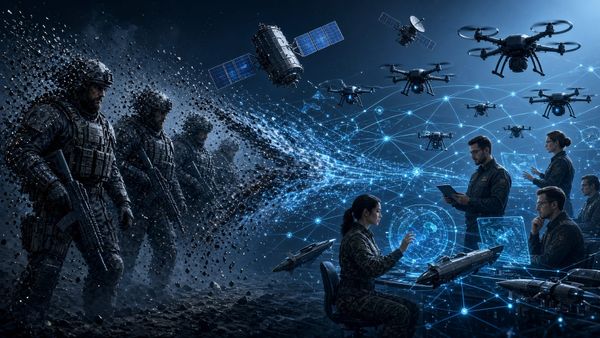
Defense startups still face enormous barriers to obtaining contracts, particularly for inexpensive systems that can be developed and iterated far faster than traditional acquisition programs. A U.S. marketplace modeled on Brave1 could allow operational units to identify, evaluate and purchase proven low-cost technologies from a much broader pool of suppliers. Cheap drones, autonomous systems, sensors, electronic-warfare tools and software should sit alongside exquisite weapons in the force structure, with procurement pathways designed for their much shorter development cycles.
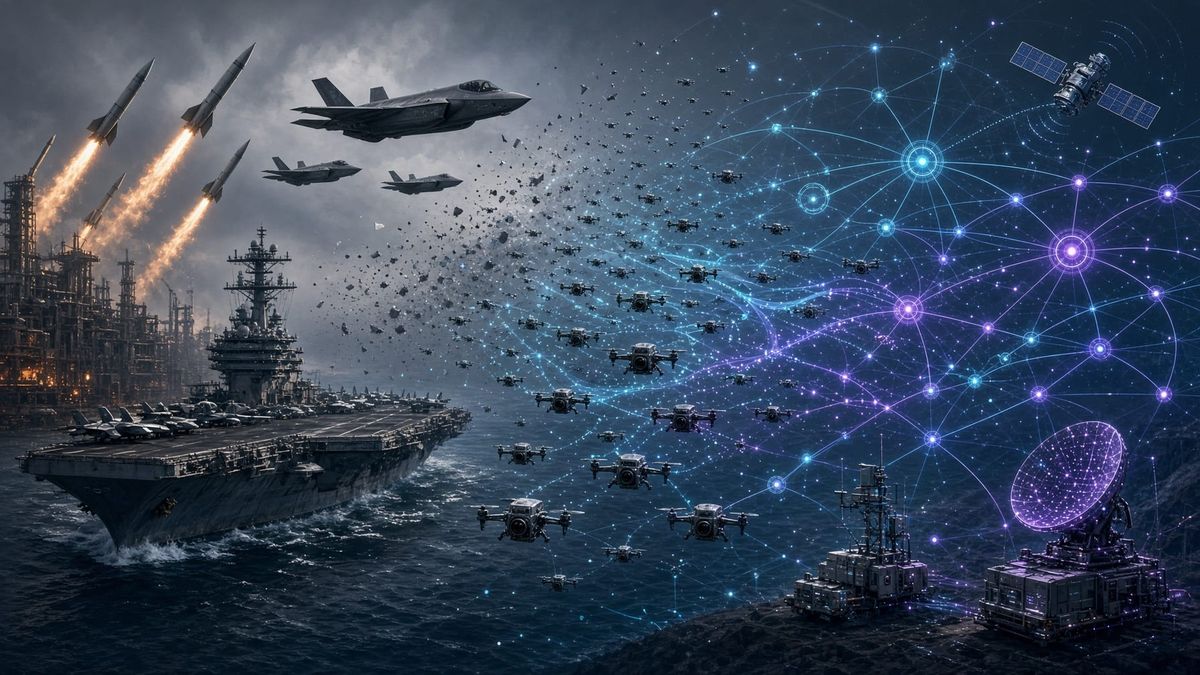
Higher defense budgets alone will not solve the problem of mass. Sending more money through the same industrial structure risks reinforcing the same bottlenecks. The United States needs a military-industrial architecture built around competition, innovation, rapid delivery, distributed production, open interfaces, second sourcing and the ability to move work rapidly between firms.
The next great-power war will require both exquisite weapons and mass. A system in which a handful of prime contractors control too much of the path from design to production is poorly suited to generating either at the speed and scale required.