
The Tetrad: Interconnected Adversaries, Fragmented American Strategy

It is almost a truism that Trump's foreign policy is incoherent. He has started a war with Iran while he coddles Putin, Xi, and Kim. The Wall Street Journal has documented Chinese shipments of components used in Iranian missile and drone production, while Western officials have reported that Russia is supplying Iran with missiles and providing intelligence to help the Iranian regime target U.S. military bases in the Middle East.
China, Russia, the DPRK, and Iran form a tetrad. While no formal treaty exists among all four, they are showing an increasing degree of cooperation, principally through bilateral and trilateral relationships.
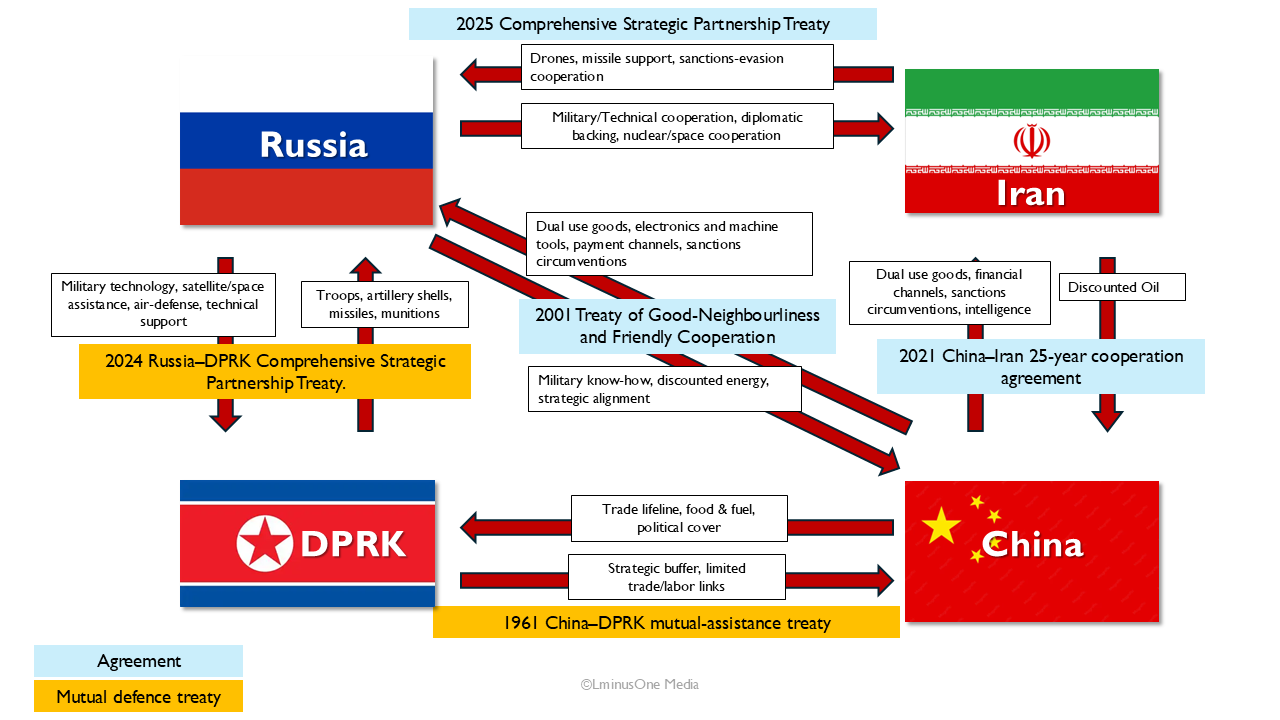
China helps Russia evade sanctions by supplying dual-use components and technologies, as well as facilitating payment channels. Russia provides China with energy, often at discounted prices, and the two countries cooperate extensively on military matters. Russia assists Iran with weapons, intelligence, and diplomatic backing. China, Russia, and Iran conduct joint naval exercises. Iran has provided Russia with drones, missiles, and assistance in evading sanctions.
China and the DPRK have a mutual defence treaty, as do Russia and the DPRK. Strategic partnership agreements exist between Iran and Russia, Russia and China, and China and Iran. The DPRK has also provided Iran with substantial assistance in developing its ballistic missile programme, and there are claims of nuclear cooperation, though these are less firmly established.
In a future war with China, the DPRK could assist Beijing by opening a second front on the Korean Peninsula, perhaps even by invading South Korea. Although its mutual defence treaty with China may not require such an action, Pyongyang might see an opportunity to exploit American military commitments elsewhere. The DPRK is already helping Russia in its war with Ukraine, providing troops, ballistic missiles, artillery, and ammunition, cooperation that has been reinforced by their mutual defence treaty.
In other words, these four countries are deeply interconnected. They have demonstrated that they are willing to provide substantial support to one another, even if their individual interests do not always coincide.
A coherent strategy would be to treat the four as a tetrad, perhaps not united by a single purpose, but sharing a deep distrust of democratic countries and the international rules-based order, which they perceive as constraints on their ambitions and threats to their own repressive rule.
One cannot treat any of these countries in isolation. A coherent defence strategy must contemplate that a war with one could involve the others, as Russia's support for Iran in the current war and the DPRK's participation in Russia's war against Ukraine demonstrate. This does not necessarily mean direct military intervention. Intelligence sharing, weapons transfers, economic assistance, and the opening of additional theatres of conflict could be sufficient to profoundly alter the strategic balance.
The United States cannot view the threat Russia poses to Europe and its war against Ukraine as Europe's problem alone. Beyond the direct assistance the members of the tetrad provide one another, they may see strategic opportunities in a distracted Europe and an increasingly isolated United States. A Europe preoccupied with confronting Russia would have fewer resources available to assist the United States in a potential conflict with China over Taiwan. Russia's assistance to Iran illustrates the converse: by helping Tehran sustain its conflict with Washington, Moscow contributes to a war that draws American forces and resources away from the Indo-Pacific theatre, thereby benefiting China, even if that is not Moscow's intention.
As such, alliances in the Indo-Pacific and Europe need to be strengthened, more funding needs to be allocated to defence, defence production must ramp up, and a coordinated Western approach must be taken to establish a global defence posture capable of constraining the imperialist ambitions of each member of the tetrad in its respective region. Deterrence is key, and the only way the United States can hope to contain the tetrad is through the force-multiplying effect of alliances.
A hot war becomes more likely if these powers see what is happening today: fraying alliances, a distracted superpower, a weakening global deterrence posture, and a transactional president who seems incapable of recognising that the threats confronting the United States and its allies are interconnected. Sadly, a sizeable part of the U.S. population shares this same failing.


