The Institutional Foundations of Freedom and Prosperity


Capitalism, internationalism, civil rights, the rule of law, and democracy reinforce one another.
That is not to say that every free-market economy is a democracy, but most established liberal democracies are market-oriented. There are good reasons for this.
For markets to thrive, several conditions are important: enforceable contracts, secure property rights, an independent judiciary, transparency, and the rule of law to ensure that individuals and businesses are treated equitably. Without these protections, markets can still function, but they are handicapped by uncertainty, distorted incentives, corruption, and opportunities for rent-seeking.
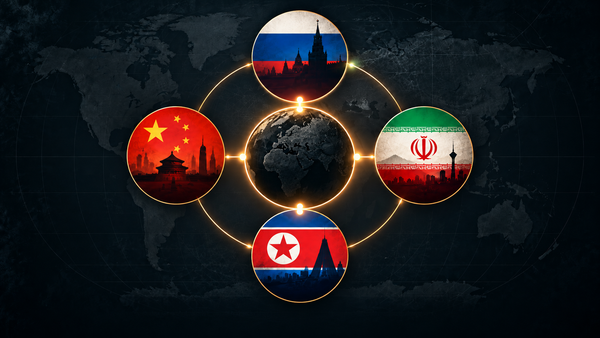
Consider China. Market reforms have delivered extraordinary economic growth, but China's economy faces enormous structural challenges, including excessive leverage (particularly in property development and local government financing), politically directed investment, and inefficient capital allocation. These problems are not exclusive to authoritarian systems, but the absence of meaningful political accountability and independent scrutiny makes identifying and correcting them more difficult.
South Korea and Taiwan offer an interesting contrast. Both achieved remarkable economic growth under authoritarian governments through market-oriented, export-driven industrialization, before transitioning to democracy. South Korea began its democratic transition in 1987, while Taiwan underwent a more gradual process of democratization beginning in the late 1980s. In both countries, economic development contributed to rising educational attainment, expanding middle classes, and increasingly assertive civil societies that demanded greater political freedom. Economic development did not make democracy inevitable, but it helped create conditions conducive to democratization. Their experiences demonstrate that capitalism and authoritarianism can coexist, but also illustrate how economic and political liberalization can eventually reinforce each other.
A free press helps expose corruption, embezzlement, and abuses of authority. Democracy helps protect press freedom by making political leaders accountable to the electorate and allowing them to be removed peacefully. However, elections alone are insufficient. Independent courts, constitutional protections, and civil liberties are essential to preventing elected governments from abusing their authority.
There is also empirical evidence that democracy contributes directly to economic prosperity. In their 2019 paper, Democracy Does Cause Growth, Daron Acemoglu, Suresh Naidu, Pascual Restrepo, and James A. Robinson found that democratization increases GDP per capita by approximately 20% over 25 years compared with countries that remain nondemocratic. The researchers identified increased investment in physical capital, education, and health as important mechanisms through which democracy contributes to economic growth.
Civil rights and democracy similarly reinforce each other. Freedom of expression makes a free press and meaningful democratic participation possible. Property rights protect individuals against arbitrary confiscation and provide an essential foundation for functioning markets. Equal treatment before the law helps prevent political privilege from becoming economic privilege.
Lastly, the modern world is a vast, interconnected economic network. Supply chains transcend national borders, and the efficient movement of materials, components, services, and finished products benefits from relatively unrestricted trade.
Tariffs and trade restrictions introduce inefficiencies, increase costs, and often create preferential treatment for politically connected industries, encouraging rent-seeking. They also interfere with one of the most fundamental principles of economics: comparative advantage. Just as specialization benefits individuals within a society, it benefits nations. Most of us do not grow our own food, stitch our own clothes, manufacture our own tools, or build our own homes. We specialize because doing everything ourselves would impose enormous opportunity costs.
The same principle applies internationally. Countries benefit by specializing in activities in which their relative opportunity costs are lowest and trading for other goods and services. Even a country that is more efficient at producing everything can benefit from trade. There may be legitimate reasons for some trade restrictions, particularly involving national security, but protectionism generally comes at an economic cost.
This brings me back to my original point.
Capitalism, internationalism, civil rights, the rule of law, and democracy are deeply interconnected. None is an absolute prerequisite for the others, but together they create a framework in which economic freedom, political accountability, individual liberty, and prosperity can reinforce one another.
When these institutions are weakened, the system becomes more brittle, creating opportunities for corruption, arbitrary power, economic distortion, and ultimately institutional decay.
It is no accident that relatively few authoritarian states have managed to combine sustained prosperity, economic openness, innovation, and strong protections for individual liberty.
These principles are not competing ideals. They are complementary foundations of a free and prosperous society.