The Infrastructure Crisis Almost No One Is Talking About

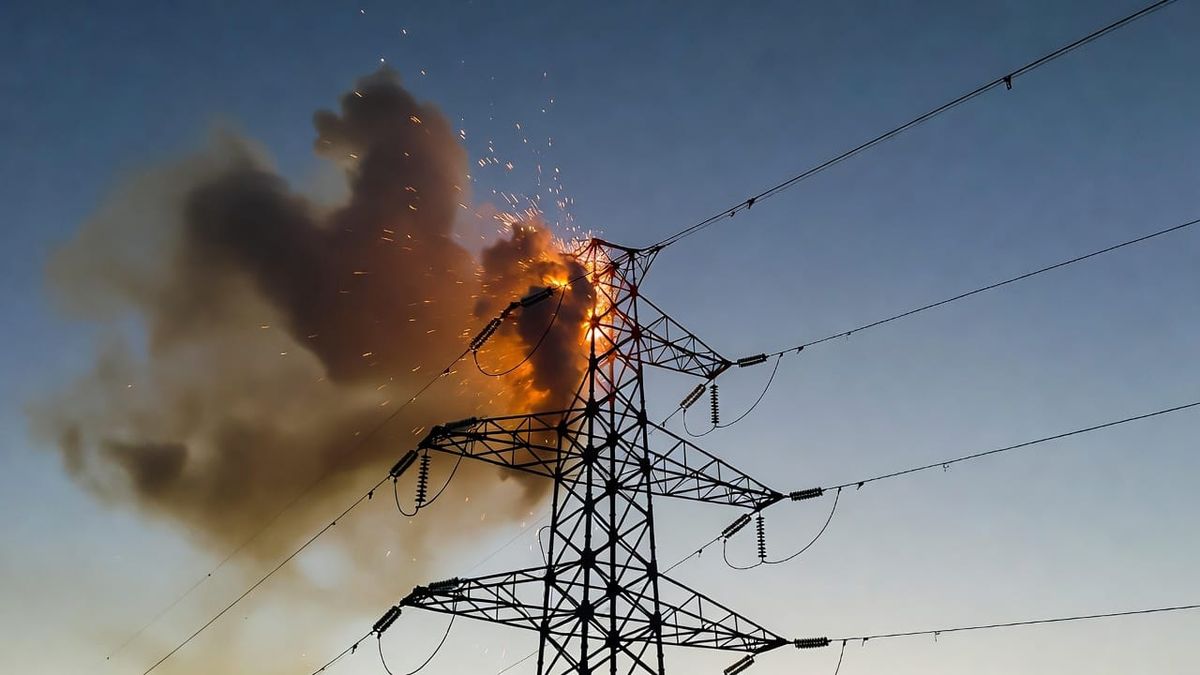
While conventional national-security coverage focuses heavily on overt threats such as nuclear weapons, carrier groups, and high-level intellectual-property theft, there is a quieter structural vulnerability within the United States that could have catastrophic consequences: long procurement delays for large power transformers and the country’s heavy dependence on just a handful of suppliers.
Most Americans notice transformers only when a small, trashcan-sized cylinder blows on a neighborhood utility pole during a thunderstorm. But the backbone of the country’s economy depends on massive, house-sized large power transformers installed at generating stations and utility substations. These industrial giants step voltage up so electricity can travel efficiently across hundreds of miles of transmission lines and then step it down as it moves towards local consumers.
The Department of Energy estimates that approximately 90% of the electricity consumed in the United States passes through a large power transformer, or LPT, at some point. Yet LPTs are among the most difficult components of the electrical grid to replace.[1]
Their vulnerability presents a profound and largely underreported national-security threat for several reasons.
The “Batch-of-One” Manufacturing Problem
Unlike standardized consumer electronics, LPTs are generally engineered for particular substations and operating requirements. They typically weigh between 150 and 400 tons, cost millions of dollars, and require specialized railcars, ships, cranes, permits, and route surveys merely to reach their destination.[1]
They are not literally incapable of being standardized, but much of the existing fleet was built around utility-specific voltage ratings, impedance requirements, dimensions, cooling systems, connections, and site constraints. Consequently, manufacturers cannot simply maintain an enormous warehouse of universally interchangeable units.
Production is also difficult to scale rapidly. It depends on specialized facilities, experienced engineers, skilled labor, grain-oriented electrical steel, copper conductors, bushings, tap changers, insulation systems, and extensive testing. Capital alone cannot immediately reproduce that industrial ecosystem.
Multi-Year Procurement Bottlenecks
Historically, utilities could often obtain an LPT within approximately 12 to 18 months. By 2024, however, the Department of Energy reported that lead times of 36 months were commonly quoted, with maximum lead times reaching as much as 60 months.[1]
Demand is being driven simultaneously by the replacement of ageing equipment, transmission expansion, renewable-energy and storage projects, domestic manufacturing investment, electrification, and the rapid construction of power-hungry AI data centers. The Department of Energy’s 2026 Draft National Transmission Needs Study identified data centers, manufacturing, large industrial loads, and broader economic growth as major sources of accelerating electricity demand.[2]
Utilities and developers are increasingly ordering equipment years in advance, refurbishing existing units, and competing for a limited number of manufacturing slots.
A transformer ordered during a crisis is therefore not a transformer available during that crisis.
Manufacturing Concentration
The United States possesses some domestic LPT manufacturing capacity, but it is nowhere near sufficient to meet national demand. According to a 2019 Department of Commerce estimate cited by the Department of Energy, 137 LPTs supplied for domestic use were produced domestically, while 617, or approximately 82%, were imported.[1]
The manufacturing base is highly concentrated. Only a small number of global companies, including Hitachi Energy, Prolec GE, Mitsubishi Electric, Hyundai Electric, Hyosung HICO, Siemens Energy, and Delta Star, possess the factories, engineering expertise, specialized labor, and high-voltage testing facilities required to manufacture LPTs at scale. This is not a market in which utilities can simply move an order among hundreds of interchangeable vendors. When the order books of several major manufacturers are full, the effective global supply ceiling has been reached.
Foreign manufacturing is not, in itself, the problem. The world operates through a large, interconnected economy, and artificially restricting transformer production to the United States would increase costs, reduce access to specialized expertise, and potentially weaken rather than strengthen the supply chain.
Foreign dependence does, however, create clear challenges, especially as they relate to logistics which we have previously mentioned.
Two measures could help address these challenges.
The first is greater international cooperation. The United States is not alone in confronting transformer shortages, ageing infrastructure, rising electricity demand, and limited manufacturing capacity. Coordination among allied countries could improve demand forecasting, facilitate mutual assistance during emergencies, identify alternative transportation routes, encourage joint investment in additional manufacturing capacity, and reduce unnecessary competition for a limited number of production slots.
The second is greater international standardization. Standards bodies already exist, including the International Electrotechnical Commission and IEEE, but their work should be expanded and more consistently incorporated into utility procurement requirements. Even where complete LPTs must remain highly customized, many of their components, accessories, dimensions, and connection interfaces do not necessarily need to be. Greater interoperability among bushings, tap changers, fittings, cooling equipment, monitoring systems, and other replaceable components would simplify repairs, enlarge the pool of qualified suppliers, permit longer production runs, and reduce the number of unique parts that utilities and manufacturers must keep in reserve.[10][11]
Complete interchangeability among LPTs is unrealistic. Greater interchangeability among their components and interfaces is not.
An Ageing Installed Fleet
LPTs are generally designed for an operating life of approximately 40 years. A frequently cited Department of Energy estimate placed the average age of North American LPTs at approximately 38 to 40 years in 2014.[1]
Transformer condition depends heavily on loading, maintenance, design, operating temperatures, refurbishment, and local environmental conditions. Some transformers continue operating for considerably longer than their nominal design life.
Nevertheless, the estimate indicates that a substantial share of the fleet is old and will eventually require replacement or major rehabilitation.
This creates a dangerous convergence: an ageing fleet, rising electricity demand, limited manufacturing capacity, and procurement times measured in years.
The Security Implications
LPTs are physically large, stationary, difficult to conceal, and often located in comparatively exposed substations.
The April 2013 attack on the Metcalf substation in California demonstrated that attackers using rifles and basic reconnaissance could damage critical grid equipment. Seventeen transformers were damaged during the attack. It did not cause a major regional blackout, but it exposed the vulnerability of large, stationary electrical equipment to relatively unsophisticated physical attacks.[3]
Cyberattacks present a different risk. An adversary might seek to disrupt protective systems, manipulate industrial controls, interfere with communications, damage equipment, or coordinate cyber operations with physical sabotage. The most serious scenario would not be the loss of one transformer but the simultaneous destruction or disabling of multiple difficult-to-replace units at carefully selected substations.
It would be an exaggeration to claim that attacking an arbitrary dozen substations would automatically black out the country. Grid topology, spare capacity, rerouting options, protection systems, regional interconnections, and the specific transformers damaged would determine the outcome.
But the interconnected nature of the grid means that a failure hundreds of miles away can contribute to instability elsewhere. A technically informed adversary targeting a small number of genuinely critical nodes could cause extensive and prolonged outages and impose a restoration problem far beyond that created by an ordinary storm.[1][4]
The Mismatch
| Metric | Reality |
|---|---|
| Electricity dependence | Approximately 90% of U.S. electricity passes through an LPT at some point. |
| LPT age | A 2014 DOE estimate placed the North American average at roughly 38 to 40 years. |
| Current lead times | Commonly measured in years, with quoted maximums reaching approximately five years. |
| Interchangeability | Limited by utility-specific engineering requirements, physical dimensions, voltage ratings, impedance, transport constraints, and site design. |
| Rapid scalability | Constrained by specialized factories, skilled labor, testing capacity, raw materials, and globally concentrated component suppliers. |
One additional source of inefficiency is the extraordinary proliferation of transformer specifications.
The Department of Energy has identified nearly 40,000 different distribution-transformer configurations nationwide and approximately 80,000 possible combinations across key technical attributes.[5]
Many of these configurations reflect legacy utility specifications accumulated over decades. Greater interoperability could make it easier for utilities to share equipment, reduce the number of production variants, and allow manufacturers to increase production runs.
The federal government has recognized the problem across administrations. In June 2022, President Biden issued presidential determinations authorizing the Department of Energy to use Defense Production Act authorities to accelerate domestic production of transformers and other critical grid components.[6]
In April 2026, President Trump issued a further determination under Section 303 of the Defense Production Act. It found that domestic capacity to design, manufacture, and deploy grid infrastructure was dangerously limited and specifically identified transformers, substations, protective systems, electrical core steel, raw materials, and manufacturing tools as resources essential to national defense.[7]
But reshoring heavy electrical manufacturing is not like opening a consumer-electronics assembly line. It requires specialized plants, enormous machine tools, qualified suppliers, trained workers, engineering expertise, and a dependable market extending over decades, not merely a temporary burst of federal funding. Attempting to reshore the entire supply chain is therefore unrealistic and undesirable. It is fundamentally wrongheaded. It would be better to work with international partners to resolve production and logistics challenges while expanding domestic capacity where genuine strategic bottlenecks exist.
What Can Be Done?
In the short term, utility companies, with support from the federal government through tax incentives, cost-sharing, and, in some cases, direct subsidies, should continue to maintain risk-based inventories of replacement components and spare LPTs that can be deployed following an emergency.
Further mitigations could include incentives for domestic grain-oriented electrical steel production and expanded utility equipment-sharing and reserve programs such as the Spare Transformer Equipment Program, or STEP.
STEP is a collective agreement among participating investor-owned utilities. Participants maintain designated spare transformers and are required to sell them to another participant following a qualifying emergency. It does not create additional national manufacturing capacity, but it can improve access to existing spare equipment.[1]
Infrastructure security can also be improved through stronger physical and cybersecurity measures.
However, this alone does not solve grid-stability problems.
If enough substations or transmission elements are disrupted, power flows will redistribute almost instantaneously across the remaining network. This can overload surviving equipment, create voltage and frequency instability, and initiate cascading failures that worsen the original disruption.
The grid must therefore retain sufficient flexibility and redundancy to compensate for isolated failures while containing wider instability through measures such as sectionalization, controlled load shedding, improved situational awareness, and intentional islanding. Building these capabilities across the grid will take time.
Over the longer term, greater standardization should be explored. This is the hardest of these problems to solve, for the reasons mentioned above, but the effort would be worthwhile.
A smaller range of standardized or flexibly configurable transformer designs, common interfaces, adjustable operating parameters, and modular replacement systems could improve compatibility, support larger-scale manufacturing, reduce replacement times, and strengthen the resilience of the electrical grid. Transformer impedance will remain particularly difficult to standardize because it depends on the surrounding network, protection systems, and the characteristics of other transformers operating in parallel.[1]
Greater use of distributed generation could also improve resilience when combined with microgrids, energy storage, appropriate control and protection systems, and the ability to operate independently from the wider grid.
Distributed generation alone is not sufficient. A local solar array, for example, will ordinarily disconnect when grid power is lost unless it is equipped with the controls, inverters, and protection systems required for intentional islanding. Properly designed microgrids, however, can disconnect from the main network and continue supplying critical loads using local generation and storage.[8]
This can limit the consequences of some wider disruptions and allow hospitals, military bases, emergency services, water systems, communications infrastructure, and other essential facilities to continue operating.
Small modular reactors and microreactors could eventually provide reliable, dispatchable, low-carbon generation within some of these systems. Some proposed SMR designs could operate independently within an islanded microgrid, provide black-start capability, and maintain substantial quantities of fuel on-site.[9]
They are not an immediate or universal solution. Their contribution will depend on whether technical, regulatory, security, fuel-supply, construction, and economic obstacles to large-scale deployment can be overcome. But where those obstacles can be addressed, they could contribute both to grid resilience and to reductions in greenhouse-gas emissions.
Conclusion
The problem is not that one damaged transformer will bring down American civilization.
The problem is that the country has allowed equipment essential to virtually every military installation, hospital, communications network, data center, factory, water system, and household to become old, difficult to replace, dependent on concentrated manufacturing, and subject to procurement delays measured in years.
That is a national-security vulnerability in the most literal possible sense.
References
[1] U.S. Department of Energy, Large Power Transformer Resilience: Report to Congress, July 2024. See especially the sections addressing LPT size and importance, procurement lead times, import dependence, fleet age, grain-oriented electrical steel, manufacturing capacity, STEP, standardization, and microgrids.
[2] U.S. Department of Energy, Office of Electricity, 2026 Draft National Transmission Needs Study, released July 9, 2026; Lawrence Berkeley National Laboratory, United States Data Center Energy Usage Report: 2025 Update, June 2026.
[3] Federal Energy Regulatory Commission, “Commissioner Bernard L. McNamee Concurrence Regarding Complaint of Michael Mabee Related to Critical Infrastructure Reliability Standard,” June 9, 2020.
[4] Federal Energy Regulatory Commission, “Reliability Explainer,” last updated August 16, 2023. See the discussion of the interconnected bulk-power system, cascading blackouts, and the August 14, 2003 Northeast blackout.
[5] U.S. Department of Energy, Office of Electricity, “Supply Chain and Market Analysis” and “Distribution Transformer Webinar Text Alternative,” March 2026.
[6] U.S. Department of Energy, “President Biden Invokes Defense Production Act to Accelerate Domestic Manufacturing of Clean Energy,” June 6, 2022.
[7] The White House, Presidential Determination Pursuant to Section 303 of the Defense Production Act of 1950, as Amended, on Grid Infrastructure, Equipment, and Supply Chain Capacity, April 20, 2026.
[8] U.S. Department of Energy, “Solar Integration: Distributed Energy Resources and Microgrids Basics”; U.S. Department of Energy, Large Power Transformer Resilience: Report to Congress, July 2024, section V.4.
[9] U.S. Department of Energy, Office of Nuclear Energy, “5 Key Resilient Features of Small Modular Reactors,” updated March 12, 2025.
[10] IEEE Standards Association, IEEE C57.12.00-2021: IEEE Standard for General Requirements for Liquid-Immersed Distribution, Power, and Regulating Transformers.
[11] International Electrotechnical Commission, IEC 60076-22-1:2019, IEC 60076-22-2:2019, and IEC 60076-22-3:2019, covering protective devices, removable radiators, heat exchangers, accessories, fittings, and dimensions relevant to interchangeability.