The Case Against Centralizing Autonomous Warfare

The more I think about AUTOWARCOM, the less convinced I am that it is a good idea.
There is an important caveat at the outset. We do not yet know exactly what AUTOWARCOM will look like. Its structure, authorities, relationship with the services, and acquisition responsibilities remain to be determined, and its establishment requires congressional approval. Project Agincourt is intended in part to develop and test the organizational concept before the command is established. My concern is therefore preliminary and principally about the direction in which the Pentagon appears to be moving.
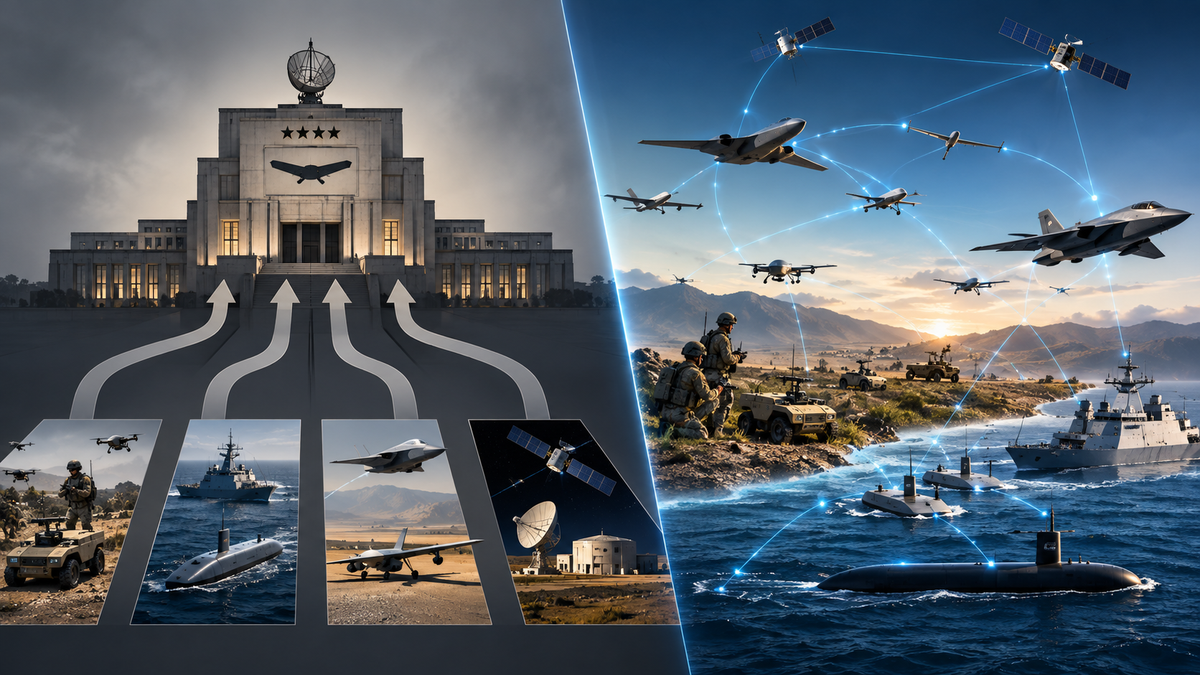
Autonomous warfare is not a separate domain like space or cyber. It is a technological and operational architecture that will have to be integrated into virtually every part of the military: air, land, sea, and space. An autonomous submarine, collaborative combat aircraft (i.e. uncrewed aircraft designed to operate alongside crewed aircraft), loitering munition, ground vehicle, and orbital system have very different operational requirements.
The proposed structure raises a more fundamental organizational problem. Goldwater-Nichols deliberately separates the services' responsibility to organize, train, and equip forces from the combatant commands' responsibility to employ them. CYBERCOM demonstrates how that boundary can erode. As cyber capabilities became increasingly important and deficiencies emerged in the forces and capabilities supplied by the services, CYBERCOM progressively acquired service-like authorities over requirements, budgets, acquisition, training, and capability development. Those authorities may have been justified by the peculiarities of cyber warfare, but they demonstrate the institutional equilibrium that can develop when a combatant command becomes responsible for an important cross-service capability: shortcomings in what the services provide create pressure for the command to acquire greater control over how those forces are developed and equipped.
AUTOWARCOM could face the same incentives on a considerably larger scale. Indeed, its proposed structure begins much further along that path: the Pentagon intends it to have directed manpower, budget, and acquisition authorities from its establishment, powers that CYBERCOM accumulated over years. If it is responsible for autonomous warfare across the joint force, every interoperability problem, capability gap, incompatible architecture, or slow procurement decision becomes an argument for expanding those authorities further. Over time, a command intended to accelerate the integration of autonomy could accumulate control over requirements, acquisition, doctrine, and technical architectures, creating another bureaucratic layer between the services and the capabilities they need. The Space Force and U.S. Space Command provide an alternative model: the Space Force organizes, trains, equips, and develops space capabilities, while Space Command employs those capabilities operationally. Joint operational integration does not require concentrating force development and operational employment in the same organization.
Ukraine provides an important lesson here. One reason Ukraine has adapted so rapidly to changes in drone warfare has been the close relationship between operators, engineers, manufacturers, and individual units, allowing systems and tactics to evolve quickly in response to battlefield conditions. Technologies, tactics, and countermeasures have consequently evolved at extraordinary speed. An organizational structure that progressively centralizes decisions over autonomous systems risks moving in the opposite direction.
A better model is federated: each service develops its own capabilities, doctrine, and operational concepts, with a smaller joint organization establishing interoperability standards, common C2 and data architectures, coordinating joint experimentation, and ensuring technology flows between the services.
SOCOM provides a useful, although imperfect, analogy. Special operations capabilities remain rooted in the individual services, while SOCOM provides a joint structure, common requirements, interoperability, and specialized acquisition capabilities. Naval Special Warfare includes the SEAL Teams and DEVGRU; USASOC includes the Green Berets, 75th Ranger Regiment, 160th SOAR, and Delta Force; AFSOC includes Air Force Special Tactics and specialized aviation units; and MARSOC includes the Marine Raiders. These are very different forces developed around the particular requirements and expertise of their respective services, but they operate within a common joint architecture.
JSOC provides another useful layer to the analogy. It sits under SOCOM and provides a joint operational structure capable of integrating selected special-mission capabilities from different services. Intelligence collection and intelligence-driven operations are deeply integrated into its activities, including close cooperation with the intelligence community. Yet DEVGRU remains a Navy capability, Delta remains an Army capability, and the underlying forces retain their service-specific expertise. A comparable structure for autonomous warfare could combine service-level development and specialization with a SOCOM-like organization responsible for standards and interoperability and, where necessary, a JSOC-like structure capable of integrating autonomous capabilities from multiple services for particular joint operations.
Acquisition should similarly remain competitive and distributed. The Army, Navy, Air Force, Marine Corps, and Space Force have different operational requirements and should be able to procure systems suited to those requirements through competitive processes rather than having technological choices dictated by a centralized autonomous-warfare bureaucracy.
This is particularly important given the creation of Project Meridian. Elon Musk and Palmer Luckey have been selected to help lead the Pentagon's study of the future of warfare while simultaneously leading companies with major existing or potential defense business. Their expertise may be valuable, but if Meridian influences requirements, architectures, or procurement priorities from which their companies could benefit, the potential conflicts of interest are obvious. Strong safeguards, transparency, and genuinely competitive procurement would be essential. No company should gain a privileged position in the emerging autonomous-warfare ecosystem because its founder helped determine what that ecosystem should look like. There is no compelling reason why the exercise could not instead be led by impartial outside experts in autonomous warfare without direct commercial interests in its recommendations.
Autonomy is likely to become ubiquitous. Autonomous systems will not constitute a discrete force operating alongside conventional air, naval, ground, and space forces. They will increasingly become components of those forces. Aircraft will cooperate with autonomous aircraft; ships with autonomous surface and subsurface vessels; ground formations with unmanned vehicles and loitering munitions; and space operations with increasingly autonomous orbital systems. The organizational objective should therefore be to make autonomy intrinsic to how each service fights.
The Pentagon may be confusing a technological revolution with a new warfighting domain. Autonomy needs to be embedded throughout the force for flexibility, innovation, adaptability, and integration, not isolated inside another four-star command.