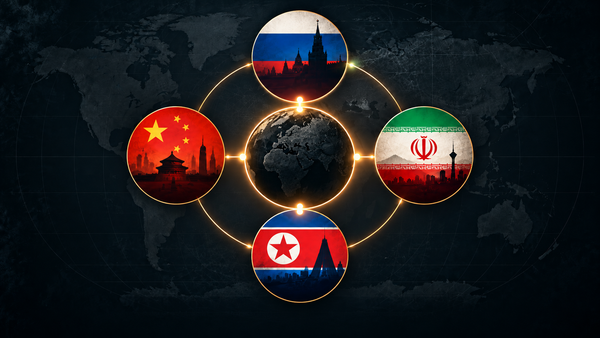
Putin's Survival Problem


Why the War No Longer Serves Russia, and Why Escalation Risk Is Rising
Executive Summary
-
The war increasingly appears to be a negative-value proposition for Russia as a state. The costs in manpower, equipment, fiscal stability, demographics, energy infrastructure, and geopolitical position are now far greater than any plausible benefit from additional occupied territory.
-
The relevant decision-maker is not Russia as an abstract national actor but Vladimir Putin and the elite coalition that depends on his survival. Their incentives may diverge from Russian national welfare.
-
Ukraine's deep-strike campaign is imposing costs inside Russia, exposing weaknesses in air defense, disrupting refining capacity, and reducing Moscow's ability to keep the war psychologically distant from the Russian political center.
-
Russian decision-makers may interpret Europe's responses to spillover and grey-zone operations as cautious to the point of flaccidity. Whether that interpretation is fair is less important than whether Moscow believes it.
-
The risk of tactical nuclear use is growing. Its logic would be coercive rather than primarily military: to shock Ukraine, divide Europe, test Washington, and reassert Russian control over escalation dynamics.
The War Comes Home
On June 18, 2026, Ukraine launched a major drone attack on Moscow, striking the Kapotnya oil refinery for the second time in a week, sending smoke over the capital and disrupting flights at Moscow airports. Reuters described the strikes as Ukraine bringing the war to Moscow, while AP reported that the attack set the refinery ablaze and disrupted commercial aviation (Reuters, June 18, 2026; AP, June 18, 2026).
Two days later, President Volodymyr Zelensky confirmed a Ukrainian drone strike against refining facilities in Tyumen, more than 2,000 kilometers from Ukrainian territory. Reuters reported that the Tyumen facility has annual processing capacity of about 6 million tons of crude oil and that Zelensky said Ukraine had developed drones capable of striking beyond 3,000 kilometers (Reuters, June 20, 2026).
The operational significance of these attacks is matched by their political significance. The Kremlin's original war model rested on insulation. The costs of the war were to be borne by Ukraine, occupied territories, mobilized soldiers, peripheral Russian regions, and the federal budget. Moscow was supposed to remain politically protected. That insulation is now weakening.
The Wall Street Journal reported on June 20, 2026, that more than 20 percent of Russia's refining capacity had been disrupted by Ukrainian drone strikes since March, producing shortages, price increases, and rationing across 53 regions. Reuters reported separately that the Russian central bank acknowledged a 25 percent fall in gasoline output compared with June 2025 and cited fuel disruption as an inflation risk (Wall Street Journal, June 20, 2026; Reuters, June 19, 2026).
The strategic question is therefore not simply whether Russia can continue the war. Russia can continue. The question is whether the war still advances Russian national interests, and whether Putin's personal incentives now differ from those of the state he rules.
A War That No Longer Pays
Russia's human losses are exceptional by any modern standard. CSIS estimated in January and February 2026 that Russian forces had suffered nearly 1.2 million casualties between February 2022 and December 2025, including roughly 275,000 to 325,000 fatalities. CSIS emphasized the uncertainty inherent in casualty estimates, but the order of magnitude is the relevant point: Russia has paid a human cost far beyond anything implied by the limited territory it has gained (CSIS, Jan. 27, 2026; CSIS, Feb. 24, 2026).
Material losses are also severe. Oryx, which counts only visually confirmed losses and therefore understates total losses by design, has documented thousands of Russian tanks and armored vehicles lost since February 2022. Russia Matters, using Oryx data, reported that Russian tank and armored-vehicle losses exceeded 14,000 by June 3, 2026 (Oryx, continuously updated; Russia Matters, June 3, 2026).
The territorial return on those losses has been poor. CSIS noted that Russia's battlefield advances have been extremely slow, including an average rate of roughly 70 meters per day in the Pokrovsk offensive. In recent months, Russia has been losing more territory than it has been gaining. In February 2026, Ukrainian forces recaptured a net of 165 square kilometers, the first time they had regained more ground than they lost since 2023 (Lviv Herald, June 9, 2026). Russia has at times consumed large quantities of manpower and equipment for marginal tactical movement (CSIS, Jan. 27, 2026).
The economic indicators are no less important. On June 19, 2026, the Russian central bank cut its key rate by only 25 basis points to 14.25 percent. Interest rates in Russia reached a peak of 21 percent in 2025. Reuters reported that the central bank cited fuel-supply disruption and fiscal risks, and that Russia's economy had contracted 0.2 percent in the first quarter of 2026 while the budget deficit had reached 2.6 percent of GDP in the first five months, already above the full-year target (Reuters, June 19, 2026).
Household inflation expectations remained elevated. Reuters reported that the Russian central bank placed household inflation expectations at 12.4 percent in June 2026. That figure is politically important because expectations shape wage demands, spending behavior, and the central bank's room to ease credit conditions (Reuters, June 17, 2026).
Russia's wartime economy is producing increasingly skewed output. IISS argued in May 2026 that Russia faces growing industrial and manpower constraints and must decide whether to mobilize the economy and society more forcefully for the war. The Atlantic Council's December 2025 report described Russia's economy as caught between stagnation and militarization, with defense-sector prioritization, dependence on China, and uneven regional effects. The Kiel Institute and SITE concluded in June 2026 that Russia's war economy was showing signs of structural exhaustion (IISS, May 18, 2026; Atlantic Council, Dec. 12, 2025; Kiel Institute and SITE, June 11, 2026).
The labor market shows the same stress. Russia's low unemployment is not a sign of strength. It reflects labor scarcity. Defense plants, the military, construction, logistics, and civilian industries are competing for the same workers. The Bell estimated in July 2024 that roughly 650,000 Russians who left after the invasion remained abroad. A CSIS study on Russia's wartime economy noted estimates that 600,000 to 1 million Russians left in 2022 and that around 400,000 to 500,000 still remained abroad as of 2025, with younger Russians forming an important part of the outflow (The Bell, July 19, 2024; CSIS, June 2, 2025).
These pressures reinforce one another. High defense spending supports short-term growth, but it pulls labor, capital, machine tools, transport capacity, and managerial attention toward the military sector. Economic concentration crowds out other industries. High interest rates suppress civilian investment. Sanctions and import controls limit access to specialized equipment. Casualties, mobilization, and emigration reduce human capital. The result is a narrower and more brittle economic model.
Geopolitically, the war has also harmed Russia. Finland joined NATO on April 4, 2023, and Sweden joined on March 7, 2024, after Russia's full-scale invasion transformed Nordic security politics. NATO's official account states that Finland's long policy of military nonalignment changed following Russia's February 2022 invasion and that Sweden joined the alliance the following year (NATO, Oct. 3, 2024).
From a Russian national-interest perspective, the war has therefore produced a poor strategic bargain: mass casualties, heavy equipment losses, inflation pressure, budget strain, labor scarcity, defense-sector hyper-specialization, refinery disruption, NATO enlargement, and a permanently hostile Ukraine.
The Principal-Agent Problem
The puzzle is why Russia continues to pay these costs.
The answer lies in a basic distinction often blurred in strategic analysis. States do not make decisions; rulers and coalitions do. Russia as a state may have strong reasons to seek an exit. Putin and the elite coalition around him may not.
For Russia, withdrawal would be costly but survivable. The country would remain damaged, sanctioned, militarized, and strategically weaker than it was in February 2022. Yet it would remain a major state with nuclear weapons, vast territory, energy resources, and a permanent seat on the UN Security Council.
For Putin, defeat may be more dangerous. Authoritarian leaders who lose major wars may face elite defection, succession struggles, prosecution, exile, assassination, or regime collapse. The more closely the war is identified with the ruler’s personal legitimacy, the higher the cost of visible failure.
This is the problem Hein Goemans identified in his work on war termination: leaders do not evaluate defeat only through the lens of national costs and benefits (Goemans, 2000). They evaluate it through the expected consequences for their own survival. In principal-agent terms, Russia is the principal whose state interests may favor ending an increasingly negative-value war. Putin and the ruling coalition around him are the agent, whose survival interests may favor continuing it if the alternative threatens regime collapse. A war can stop serving the state while still serving the ruler.
Gambling for Resurrection
Political scientists often describe this dynamic as gambling for resurrection. When leaders face deteriorating circumstances and fear catastrophic personal outcomes, they may adopt riskier strategies because moderate options no longer protect their position. The logic is not irrationality. It is a change in the payoff matrix.
Historical examples show the pattern. In 1945, Adolf Hitler continued a hopeless war after Germany's defeat was unavoidable, choosing military and ideological commitment over German national survival. In 1982, Argentina's military junta invaded the Falkland Islands amid economic crisis and domestic legitimacy problems, using external conflict to try to preserve internal control. Saddam Hussein's decisions in 1990 imposed catastrophic costs on Iraq while reflecting the calculations of a ruler whose personal survival incentives differed from the long-term interests of the Iraqi state.
The common feature is divergence. Leaders facing political ruin may prefer risky escalation to certain defeat. Putin does not need to believe escalation is safe. He only needs to believe restraint is worse.
Unlike Argentina’s Galtieri, who gambled on a quick external victory to save a failing domestic regime, Putin is gambling on prolonged attrition, betting that his highly consolidated authoritarian apparatus can absorb structural economic exhaustion longer than Western democracies can maintain political cohesion. That thinking can lead to catastrophic consequences if it turns out to be wrong. By prolonging the conflict, Russia’s eventual payoff for cessation of hostilities will be lower, but Putin may believe otherwise until circumstances force a re-evaluation of those beliefs with the attendant risk of escalation.
Ukraine's Deep-Strike Campaign
Ukraine's long-range strike campaign has intensified the pressure on Putin's survival calculus. For much of the war, Russia could keep the conflict geographically and psychologically distant from Moscow. Ukrainian strikes on refineries, air bases, logistics hubs, and the capital itself have reduced that distance.
The June 2026 Moscow refinery strikes are a clear example. Reuters reported that Ukrainian drones hit the same Moscow refinery twice in three days and that the facility lies within Moscow's ring road, only miles from the Kremlin. AP reported that the attack disrupted commercial flights at four Moscow airports and affected hundreds of flights (Reuters, June 18, 2026; AP, June 18, 2026).
The Tyumen strike changed the geography further. A Ukrainian strike more than 2,000 kilometers from Ukraine demonstrates that distance alone no longer protects major Russian industrial assets. Even where Russian officials claim limited or no damage, the requirement to defend such facilities imposes costs (Reuters, June 20, 2026).
Russia's air-defense system is also under growing strain. ISW's June 18, 2026 assessment cited CBS reporting that Ukrainian officials familiar with Russian intelligence estimates said Russia was experiencing a shortage of S-300 air-defense missiles, particularly because sanctions limited key components such as guidance seekers and control modules. CBS described Ukraine's deep strikes as leaving Russia short on air-defense missiles, potentially at an unsustainable rate. Its strategic implication is important: Russia must defend too many targets with finite interceptors, sensors, launchers, and trained crews (ISW/Critical Threats, June 18, 2026; CBS News, June 17, 2026).
The economics of the exchange are unfavorable to Russia. A Ukrainian long-range drone costing tens of thousands of dollars can force Russia to expend interceptors that cost hundreds of thousands or millions, or to reposition scarce systems around politically sensitive infrastructure. Every S-300 or S-400 battery moved to protect Moscow, refineries, air bases, ports, logistics nodes, or occupied territory leaves some other target more exposed.
Ukraine's objective is not necessarily to destroy every target it attacks. It is to force Russia into a resource-allocation problem. Concentrating defenses around Moscow and strategic sites leaves energy and military infrastructure elsewhere vulnerable. Dispersing defenses lowers protection density around the capital and other politically sensitive nodes. Either choice imposes costs.
Western Deterrence and Russian Learning
The probability of escalation depends not only on Russian capabilities and incentives but on Russian perceptions of Western resolve. Deterrence is a problem of expectations. The key question is not what NATO or the United States would objectively do after future Russian escalation. The key question is what Russian decision-makers believe NATO or the United States would do.
Since 2022, Moscow has accumulated evidence that Western governments are cautious, incremental, and highly focused on escalation management. HIMARS, Patriot systems, Leopard and Abrams tanks, F-16s, Storm Shadow missiles, and ATACMS were all debated as potentially escalatory before later being supplied. Restrictions on Ukrainian strikes against Russian territory were also relaxed gradually. From a Western perspective, this was prudent adaptation. From Moscow's perspective, it may look like repeated Western self-deterrence followed by delayed adjustment.
Russian planners may also draw conclusions from NATO's response to direct spillover onto alliance territory. On May 29, 2026, Romania said a Russian drone entered Romanian airspace during attacks on Ukraine and struck an apartment building in Galati, injuring a woman and a child. Romania had scrambled F-16s and a military helicopter but did not intercept the drone; NATO and European officials condemned the incident, Romania requested expedited NATO anti-drone support, and Romania declared the Russian consul in Constanta persona non grata (Reuters, May 29, 2026; AP, May 29, 2026).
Romania did not invoke Article 4 consultations, and no military response followed. From a European perspective, restraint was defensible because officials did not present the incident as a deliberate Russian attack on Romania and because escalation with a nuclear power carries obvious risks. From Moscow's perspective, however, the response may look flaccid: a Russian drone hit a residential building inside NATO territory, injured civilians, and produced condemnation, diplomatic measures, additional air-defense requests, and sanctions rather than coercive military costs.
The Russian reaction reinforced that interpretation. Reuters reported that Dmitry Medvedev warned European countries to brace for more drone incidents after the Romania episode. Moscow also deflected responsibility. Whether the Kremlin truly intended the Galati incident is less important than the likely lesson drawn from the response: even civilian casualties on NATO territory may remain within a manageable escalation band (Reuters, May 29, 2026).
The same perception problem applies to Washington. No prominent presidential-level American warning comparable to NATO's institutional statements had been made. Russian officials may interpret that silence, along with President Trump's broader preference for avoiding direct confrontation with Russia, as evidence that the United States would hesitate to respond militarily to a limited Russian tactical nuclear strike in Ukraine. That inference may be wrong. Deterrence, however, depends on Moscow's beliefs, not Washington's private intentions. That discrepancy is where there is a catastrophic risk of escalation based on a misunderstanding of each other’s position.
The Grey-Zone Precedent
Russia has also tested Western thresholds through grey-zone operations below the level of open war. Since 2022, European governments and intelligence services have linked Russia or Russian-associated networks to sabotage, cyberattacks, arson, influence operations, assassination planning, GPS interference, and attacks or suspected attacks on critical infrastructure.
One prominent example emerged in July 2024, when Reuters reported that U.S. intelligence had uncovered a Russian plan to assassinate Armin Papperger, chief executive of Rheinmetall, Germany's largest defense manufacturer and a major supplier to Ukraine. Germany said it would not be intimidated. In January 2025, Reuters reported that NATO official James Appathurai confirmed that threats to plot the murder of industry leaders, including Papperger, were part of a broader sabotage campaign that included train derailments, arson, attacks on politicians' property, and other plots (Reuters, July 11, 2024; Reuters, Jan. 28, 2025; Reuters, July 12, 2024).
CSIS reached a similar conclusion in March 2025, describing Russia's shadow war against the West as an escalating and violent campaign of sabotage and subversion led by Russian military intelligence, and stating that the number of Russian attacks nearly tripled between 2023 and 2024 (CSIS, Mar. 18, 2025).
Critical infrastructure has been another target category. NATO announced Baltic Sentry in January 2025 after repeated incidents involving undersea cables and energy links in the Baltic Sea. AP reported that NATO Secretary General Mark Rutte said undersea cables carry more than 95 percent of internet traffic and roughly $10 trillion in daily financial transactions, and that the mission would involve frigates, maritime patrol aircraft, and naval drones. Carnegie's June 2025 analysis connected suspected cable incidents to Russia's shadow fleet and the broader problem of protecting subsea infrastructure (AP, Jan. 14, 2025; Carnegie Endowment, June 5, 2025).
The European response has not been nonexistent. It has involved arrests, intelligence cooperation, expulsions, sanctions, public attribution, and defensive missions. Yet the pattern remains tepid in strategic terms. Russia has seen repeated examples in which sabotage, assassination planning, critical-infrastructure disruption, and drone spillover produced managed responses rather than direct punishment.
This does not prove that Europe is weak. It suggests that Moscow may assess Europe as highly risk-averse. In deterrence theory, a risk-averse adversary can possess formidable capability and still be vulnerable to coercion if it consistently signals that escalation avoidance is its overriding objective.
Nuclear Coercion as an Extension of Existing Strategy
Nuclear escalation should not be understood as a sudden departure from Russian strategy. Russia has used nuclear coercion throughout the war through official threats, exercises, doctrinal signaling, deployments of tactical nuclear weapons to Belarus, and repeated references to the risk of nuclear confrontation. The question is not whether Russia uses nuclear threats. It does. The question is whether the Kremlin could conclude that signaling alone is no longer sufficient.
After the June 2026 attack on Moscow, Russian Foreign Minister Sergey Lavrov is reported to have said “I believe that all the right words have been said, but I have long been convinced that words are not enough.” (Anadolu Agency, June 18, 2026) While his words do not indicate any imminent nuclear attack, they do strongly imply an intention to escalate. The question is: escalate to what? Russia has already carried out massive air strikes on Ukraine, killing thousands, destroying billions of dollars’ worth of infrastructure, and terrorizing Ukrainian civilians. But these attacks have not achieved their goal of breaking Ukrainian will.
A tactical nuclear strike would not need to achieve decisive battlefield effects. Its purpose could be political: to shock Ukraine, divide European governments, test Washington’s willingness to incur risk, freeze the battlefield, and reassert Russian control over escalation dynamics. Such a strike would be consistent with the coercive logic often described as Russia’s “escalate to de-escalate” strategy.
Such a strike could take several forms. Russia could conduct a demonstration detonation over an unpopulated area, strike a Ukrainian military formation, target a logistics hub, or escalate through visible nuclear deployments and exercises short of use. Each option would be designed to change expectations rather than simply destroy a target.
The costs to Russia could be substantial. Nuclear use could strengthen Western support for Ukraine, damage Moscow’s relations with China and India, increase Russia’s isolation, and provoke conventional military responses against Russian forces or assets connected to the attack. From a Russian state-interest perspective, nuclear use could be profoundly damaging.
But that depends on what Moscow expects others to do. If Russian decision-makers believe the response would be scolding, sanctions, and carefully bounded military signaling, or non-signaling as the case may be, they may conclude that even nuclear use would remain within a manageable escalation band.
The relevant question is whether Putin might judge nuclear coercion preferable to visible defeat. If he believes conventional victory is slipping away, that defeat threatens his survival, and Western retaliation would remain limited, the expected utility of nuclear coercion rises.
Policy Implications
Western policy should start from the assumption that Russia's state-level interests and Putin's personal survival interests may diverge. Russia has strong reasons to avoid nuclear escalation. Putin may have reasons to accept risks that damage Russia if he believes those risks improve his own prospects of survival. Putin’s calculus may still be rational, but if he believes his survival is threatened, escalation that diverges from his previous decision patterns poses grave risks by introducing greater uncertainty into the strategic interaction and increasing the likelihood of Bayesian updating errors.
Deterrence should therefore be aimed at the ruler’s payoff structure. The United States and Europe should communicate, publicly and privately, that any Russian nuclear use in Ukraine would produce severe, immediate, and military consequences. The response need not involve nuclear use. It must, however, be credible enough to convince Moscow that nuclear use would worsen Russia’s military and political position rather than improve it. A military response could include, in ascending order of escalation, providing Ukraine with unrestricted long-range strike assets and deep targeting data, deploying armed military advisors inside Ukraine, establishing robust no-fly zones in the western part of Ukraine, changing NATO’s nuclear posture through the forward deployment of tactical nuclear weapons (TNWs) to Eastern Europe, or even striking military units and associated command nodes responsible for the nuclear attack with conventional munitions.
But for Europe and the United States to convince Moscow that Western threats are credible, they must react more strongly to the ongoing salami tactics used by Russia to test Western resolve. So far, Russia has every reason to believe that Western response will be a sharply worded rebuke, movement of air defense systems, and more sanctions.
For example, Europe should reduce the perception that grey-zone attacks are low-cost. Sabotage, assassination planning, critical-infrastructure disruption, and drone incursions should produce predictable consequences that are visible to Russian planners. Sanctions and expulsions are necessary but insufficient if they become the default response to each new threshold test.
NATO territory requires a clearer operational threshold. A drone strike that injures civilians inside a NATO member state should trigger at least immediate consultations, enhanced air-defense deployments, and a public statement of consequences for repeated incidents with follow-up should those incidents repeat. A military response, including expanded intervention involving NATO country troops in support of Ukraine, should be on the table. The alliance does not need to respond recklessly. It does need to prevent Russia from learning that spillover into NATO territory is merely an administrative inconvenience.
Negotiating with Putin on terms that reward aggression also carries fundamental risks. Russia’s war against Ukraine is a war of conquest. In a war of conquest, the only just outcome is the withdrawal of the conquering forces. Pragmatically, negotiations may happen, but negotiations that trade Ukrainian sovereignty for Russian restraint carry a serious moral hazard: they risk validating the invasion in the eyes of the conqueror, even if Russia’s broader objectives have been curtailed. Negotiations at this juncture may also create the impression in Moscow that Europe and Ukraine are negotiating from weakness. Worse, they may teach Russia that attempted conquest, even against a NATO-member state, could eventually produce a negotiated settlement that benefits the aggressor.
Aside from the moral hazard involved, the implication for Moscow is that the West’s normative framework is negotiable and fungible. Western governments must take peace-for-territory deals off the table as contrary to the rules-based international order. The Stimson Doctrine was a foreign policy introduced by Secretary of State Henry L. Stimson and grounded in the principle ex injuria jus non oritur: law does not arise from injustice. It emerged in response to Japan’s invasion of Manchuria in 1931 and held that territorial changes imposed by aggression should not be recognized as legitimate. The same logic underpins the modern principle of non-recognition: states should not validate territorial acquisition achieved through force. Article 2(4) of the UN Charter reinforces this principle by prohibiting the threat or use of force against another state’s territorial integrity or political independence.
To deny this principle in the name of preserving a semblance of peace is ultimately futile and works contrary to the idea of deterrence. It does not end the danger; it rewards the method. It encourages further adventures by a reckless man using the machinery of the Russian state, and it teaches him that aggression can be converted into bargaining leverage if it is sustained long enough.
Ukraine's deep-strike campaign has changed the war. It is imposing measurable costs on Russia's refining capacity, fuel supply, air defense, logistics, and domestic confidence. It is also increasing pressure on Putin's regime-survival calculus. That combination makes deterrence more important, not less.
The central issue is not whether Russia can continue fighting. It can. The central issue is whether Putin believes he can survive politically if the war ends without achieving its objectives. If he concludes that the answer is no, escalation incentives increase. Western policy should be designed to ensure that escalation appears even more dangerous to him than failure. At the moment, it is failing in that task, and achieving the opposite, leading Russia to conclude that Western tolerance for its mischief is much higher than it might actually be.
References
Anadolu Agency, “Lavrov warns of regular massive strikes after Ukrainian drone attack on Moscow”, June 18, 2026, https://www.aa.com.tr/en/eurasia/lavrov-warns-of-regular-massive-strikes-after-ukrainian-drone-attack-on-moscow/3971088
AP, "NATO announces a new mission to protect undersea cables in the Baltic Sea region," Jan. 14, 2025. https://apnews.com/article/b8d351fa018d703fe9dbc50459211e61
AP, "Russian drone targeting Ukraine hits apartment building in Romania, injuring 2, officials say," May 29, 2026. https://apnews.com/article/aa90986c237b8fa1d9116685c8c32f95
AP, "Ukrainian drones set a Moscow refinery ablaze in a major attack on the Russian capital," June 18, 2026. https://apnews.com/article/0ee97c720e770c392067418f9cabcbba
Atlantic Council, "The Russian economy in 2025: Between stagnation and militarization," Dec. 12, 2025. https://www.atlanticcouncil.org/in-depth-research-reports/report/the-russian-economy-in-2025-between-stagnation-and-militarization/
The Bell, "Russia's 650,000 wartime emigres," July 19, 2024. https://en.thebell.io/russias-650-000-wartime-emigres/
Carnegie Endowment, "The Baltic Sea at a Boil: Connecting the Shadow Fleet and Cable Sabotage," June 5, 2025. https://carnegieendowment.org/research/2025/06/baltic-russia-maritime-cable-sabotage
CBS News, "Ukraine's deep strikes leaving Russia short on air defense missiles," June 17, 2026. https://www.cbsnews.com/news/ukraine-russia-war-moscow-air-defense-interceptor-shortage-drone-strikes/
CSIS, "Russia's Grinding War in Ukraine," Jan. 27, 2026. https://www.csis.org/analysis/russias-grinding-war-ukraine
CSIS, "Russia's Shadow War Against the West," Mar. 18, 2025. https://www.csis.org/analysis/russias-shadow-war-against-west
CSIS, "Russia-Ukraine War in 10 Charts," Feb. 24, 2026. https://www.csis.org/analysis/russia-ukraine-war-10-charts
CSIS, "The Russian Wartime Economy," June 2, 2025. https://csis-website-prod.s3.amazonaws.com/s3fs-public/2025-06/250605_Snegovaya_Wartime_Economy.pdf
Goemans, H. E., War and Punishment: The Causes of War Termination and the First World War, Princeton University Press, 2000.
IISS, "The Coming Crisis in Russia's Political Economy," May 18, 2026. https://www.iiss.org/research-paper/2026/05/the-coming-crisis-in-russias-political-economy/
ISW/Critical Threats, "Russian Offensive Campaign Assessment, June 18, 2026," June 18, 2026. https://www.criticalthreats.org/analysis/russian-offensive-campaign-assessment-june-18-2026
Kiel Institute for the World Economy and SITE, "Endgame: Russia's war economy hits its limits," June 11, 2026. https://www.kielinstitut.de/publications/news/endgame-russias-war-economy-hits-its-limits/
Lviv Herald, “The Ukrainian Frontline in June 2026”, June 9, 2026, https://www.lvivherald.com/post/the-ukrainian-front-line-in-june-2026
NATO, "Relations with Finland," updated Oct. 3, 2024. https://www.nato.int/en/what-we-do/partnerships-and-cooperation/relations-with-finland
Oryx, "Attack on Europe: Documenting Russian Equipment Losses During the Russian Invasion of Ukraine," continuously updated. https://www.oryxspioenkop.com/2022/02/attack-on-europe-documenting-equipment.html
Reuters, "Germany says it won't be cowed by Russia after reported plot to kill Rheinmetall CEO," July 12, 2024. https://www.reuters.com/world/europe/germany-says-it-wont-be-cowed-by-russia-after-reported-plot-kill-rheinmetall-ceo-2024-07-12/
Reuters, "Murder plot against Rheinmetall CEO was part of sabotage campaign, NATO says," Jan. 28, 2025. https://www.reuters.com/world/europe/threat-plot-murder-rheinmetall-ceo-was-part-sabotage-campaign-nato-says-2025-01-28/
Reuters, "Romania says Russian drone hit apartment block, NATO vows to defend alliance territory," May 29, 2026. https://www.reuters.com/world/europe/apartment-building-hit-by-drone-romanias-galati-close-ukraine-border-radio-says-2026-05-29/
Reuters, "Russia tried to assassinate CEO of arms firm sending weapons to Ukraine, CNN reports," July 11, 2024. https://www.reuters.com/world/europe/russia-tried-assassinate-ceo-arms-firm-sending-weapons-ukraine-cnn-reports-2024-07-11/
Reuters, "Russian central bank says household inflation expectations fall to 12.4% in June," June 17, 2026. https://www.reuters.com/business/russian-central-bank-says-household-inflation-expectations-fall-124-june-2026-06-17/
Reuters, "Russian central bank trims rate by 25 bps to 14.25% amid fuel supply, budget risks," June 19, 2026. https://www.reuters.com/business/russian-central-bank-trims-rate-by-25-bps-1425-amid-fuel-supply-budget-risks-2026-06-19/
Reuters, "Russian official warns Europe to brace for more drone incidents after Romania episode," May 29, 2026. https://www.reuters.com/world/europe/russian-official-warns-europe-brace-more-drone-incidents-after-romania-episode-2026-05-29/
Reuters, "Ukraine brings the war to Moscow as huge blasts shake refinery," June 18, 2026. https://www.reuters.com/world/europe/ukraine-brings-war-moscow-huge-blasts-shake-refinery-2026-06-18/
Reuters, "Ukraine's Zelenskiy confirms drone strike on refining facilities in Russia's Tyumen region," June 20, 2026. https://www.reuters.com/business/energy/ukraines-zelenskiy-confirms-drone-strike-refining-facilities-russias-tyumen-2026-06-20/
Reuters, "Zelenskiy warns of impending massive Russian attack on Ukraine," June 20, 2026. https://www.reuters.com/world/europe/zelenskiy-warns-impending-massive-russian-attack-ukraine-2026-06-20/
Russia Matters, "Russia-Ukraine War Report Card, June 3, 2026," June 3, 2026. https://www.russiamatters.org/news/russia-ukraine-war-report-card/russia-ukraine-war-report-card-june-3-2026
Wall Street Journal, "Russia Faces Spreading Fuel Shortages After Ukrainian Drones Pummel Refineries," June 20, 2026. https://www.wsj.com/world/russia-faces-spreading-fuel-shortages-after-ukrainian-drones-pummel-refineries-60e96bc0
Methodology Note
This draft uses public reporting and open-source analysis available as of June 20, 2026. Casualty figures are estimates and should be treated as approximate. Oryx and WarSpotting-style equipment data count only visually confirmed losses and therefore generally understate total losses. Claims about Russian air-defense missile shortages rely on reported Ukrainian intelligence estimates cited by CBS and ISW and should be framed as reported rather than independently verified. Allegations involving Russian-linked sabotage in Europe are based on public reporting, NATO statements, and law-enforcement or intelligence claims; individual incidents may vary in the strength of attribution.