
The Gracchi, Institutional Rigidity, and the Strategic Logic of Republican Collapse

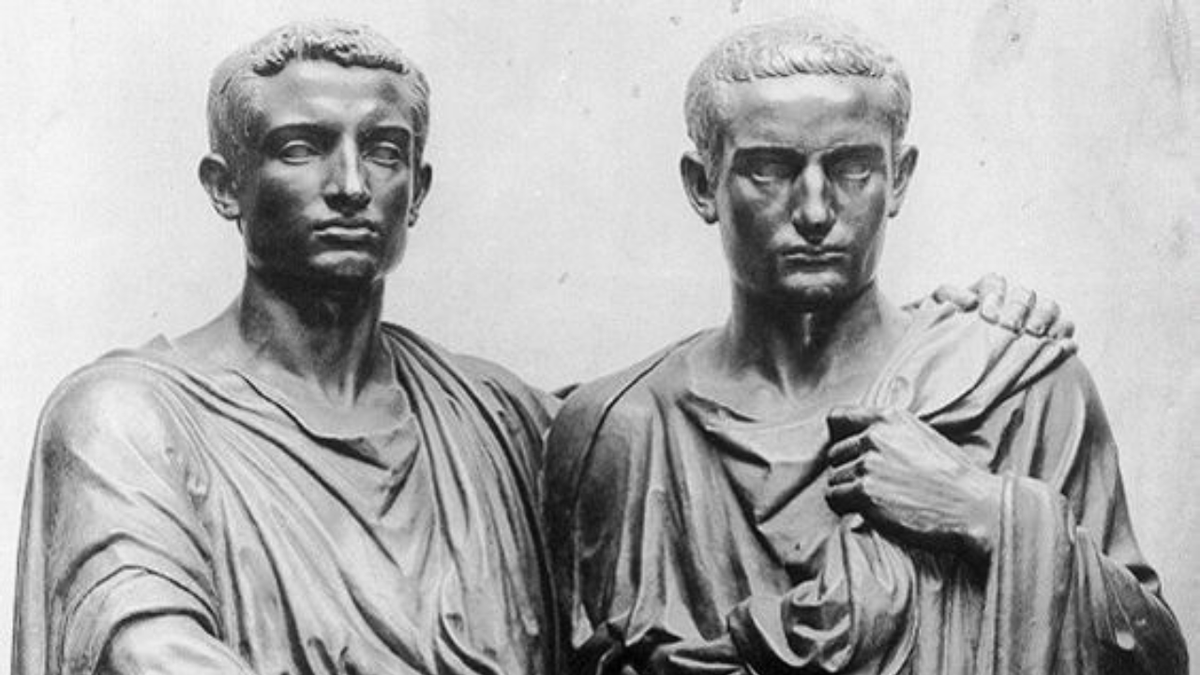
Reform, elite capture, and the erosion of republican equilibria
Core thesis: The Gracchi brothers correctly identified a substantive crisis in the Roman Republic, but they misdiagnosed the level at which the crisis had to be solved. Land reform was necessary, yet by the late second century BCE institutional rigidity and elite capture had become the first-order problem. Their decision to bypass senatorial obstruction, followed by the Senate’s resort to political violence, helped shift Roman politics from a constrained repeated game into an escalating contest in which future actors could rationally treat institutions as obstacles rather than binding rules.
Chronological Spine
| Event | Date | Analytical significance |
|---|---|---|
| Battle of Pydna; Rome defeats Macedon | 168 BCE | Illustrates conquest, plunder, and asymmetric elite enrichment. |
| Tiberius Gracchus elected tribune and murdered | 133 BCE | First Gracchan crisis; institutional bypass meets elite violence. |
| Gaius Gracchus tribunate | 123-122 BCE | Broader reform programme targeting senatorial dominance. |
| Death of Gaius Gracchus | 121 BCE | Second violent termination of reform politics. |
| Marius becomes consul | 107 BCE | Military and political relationships begin shifting toward personal command. |
| Sulla marches on Rome | 88 BCE | An army is used against the Republic itself. |
| Sulla as dictator | 82-79 BCE | Constitutional reconstruction through coercion. |
| Pompey’s extraordinary commands | 60s BCE | Exceptional individuals increasingly operate above ordinary republican limits. |
| First Triumvirate | 60 BCE | Informal elite coordination outside ordinary constitutional forms. |
| Caesar consul | 59 BCE | Caesar enters the highest magistracy. |
| Caesar crosses the Rubicon | 49 BCE | Open civil war; culmination of accumulated precedent. |
Introduction
The crisis of the Gracchi brothers was not merely a dispute over land distribution, nor was it simply an episode in the moral decline of the Roman aristocracy. It was a systemic failure in which economic transformation, elite capture, institutional rigidity, and strategic escalation interacted to produce a new political equilibrium. The Roman Republic’s victories in the Mediterranean generated wealth, enslaved labour, tribute, military prestige, and new forms of provincial extraction. Yet these gains were distributed asymmetrically. The senatorial and equestrian elites were better positioned to exploit the opportunities created by conquest, while many citizen-farmers, whose social and military role had been central to the earlier Republic, found themselves increasingly marginalized.
The Gracchi correctly identified the social and economic pathology. Their reforms were substantively necessary, or at least defensible, given the pressures generated by land concentration, rural displacement, and military manpower concerns. Their strategic error, however, was that they treated land reform and redistributive legislation as first-order problems when, by the late second century BCE, the more fundamental issue was institutional incapacity. The Roman Republic had become less able to process necessary reform through legitimate channels. The Senate, dominated by those with a strong material interest in the status quo, could obstruct reform through formal and informal mechanisms while preserving the outward appearance of republican legality.
The resulting crisis was therefore not simply a conflict between reformers and conservatives. It was a coordination failure inside a decaying constitutional order. The Gracchi attempted to bypass obstruction through popular mechanisms; their opponents responded with violence. In game-theoretic terms, the interaction shifted from a repeated institutional bargaining game, in which actors expected future cooperation under shared rules, to an escalating contest in which each side updated its beliefs about the other’s willingness to defect. Once political violence entered the strategic repertoire, subsequent actors inherited a lower threshold for extra-institutional action. Marius, Sulla, Pompey, and Caesar did not emerge in a vacuum. They operated in a political system whose equilibria had been altered by earlier precedents.
I. War, Conquest, and the Distributional Consequences of Roman Success
A useful point of departure is 168 BCE, when Rome defeated Macedon at the Battle of Pydna. The battle was a decisive engagement in the Third Macedonian War and resulted in the end of the Macedonian monarchy under Perseus. Its significance for the present argument is not merely military. It illustrates the economic and political structure of Roman conquest: victory generated plunder, prisoners, provincial revenues, military commands, and commercial opportunities.
Conquest expanded the domain over which Roman elites could operate. Land exploitation, tax-farming, mining rights, public contracts, and patronage networks became increasingly important mechanisms through which imperial success was converted into private advantage. The distributive effect was asymmetric. The Roman citizen-farmer did not benefit from conquest in the same way as those who possessed land, capital, enslaved labour, credit networks, and political access.
Large landowners could incorporate enslaved labour into agricultural production, purchase or occupy additional land, and absorb fluctuations that would have ruined smaller producers. By contrast, the smallholder who served in extended military campaigns often returned to debt, neglected property, and a more competitive rural economy. The burden of service and the benefits of conquest were therefore not aligned and certainly not uniform.
The Roman Republic was not merely a state apparatus. It was a socio-military order. The citizen-farmer was not simply an economic category but a political and military one. If conquest undermined the material basis of the citizen body, then land concentration was not a discrete agrarian problem. It threatened the Republic’s military recruitment base, civic equilibrium, and legitimacy.
In game-theoretic terms, Roman expansion altered the payoff structure facing elite and non-elite actors. For the elite, conquest produced increasing returns: political office generated access to command; command generated wealth and prestige; wealth and prestige increased the probability of future office. For smallholders, the returns were more ambiguous. Military service could produce honour and limited spoils, but it also imposed opportunity costs and increased exposure to debt. This divergence generated a distributional conflict: the system as a whole became more powerful, but the marginal benefits accrued disproportionately to those already able to exploit the institutional architecture of empire.
II. Elite Capture and Institutional Rigidity
By the second century BCE, the Senate remained the prestige centre of Roman political life. It was not a sovereign legislature in the modern sense, but it exerted enormous influence over public finance, foreign policy, military commands, elite careers, provincial administration, and the norms governing legitimate political action. The Senate’s authority rested partly on formal practice and partly on accumulated prestige, custom, and aristocratic coordination.
The problem was not simply that Rome had wealthy elites. The problem was that the class benefiting most from the political economy of conquest was embedded in the institutions that would have had to correct the consequences of conquest. Those most able to diagnose and remedy the structural crisis were often those least incentivized to do so.
This is the core of elite capture. It does not require formal dictatorship, nor does it require the abolition of republican institutions. Indeed, its most stable form often preserves institutional appearance while narrowing substantive possibility. The Senate could continue to deliberate, magistrates could continue to serve, assemblies could continue to vote, and tribunes could continue to intervene, while the practical range of acceptable reform was constrained by aristocratic interest.
The result was institutional sclerosis. Procedures and norms that had once mediated elite competition became mechanisms for preserving distributive advantage. Veto points, patronage networks, informal sanctions, reputational pressure, and control over political careers all limited the feasibility of reform. In such an environment, the relevant problem is not whether reform is normatively desirable but whether the institutional system can process it without destabilizing itself.
By the time the Gracchi entered politics, Rome’s institutions had not collapsed. They had become less capable of adaptation. They had become old and stiff.
Collapsed institutions are obvious. Sclerotic institutions are more dangerous because they continue to function procedurally while failing substantively. They produce the appearance of order while increasing the incentive for extra-institutional action: if the mechanisms of the state fail to allow change, then bypass them.
III. Tiberius Sempronius Gracchus: The Reform Programme
Tiberius Sempronius Gracchus was born sometime between 169 and 164 BCE and died in June 133 BCE. He came from one of Rome’s most prestigious aristocratic families. His mother, Cornelia, was the daughter of Scipio Africanus, the conqueror of Hannibal; through family and marriage, Tiberius was linked to the highest circles of Roman politics. He was therefore not an outsider. His reformism emerged from within the aristocracy, not from a revolutionary movement external to the Republic’s governing class. He was less a Malcolm X than a Kennedy.
Tiberius served in the military, including during Rome’s wars in Carthage and Spain. His political consciousness was shaped by both elite education and direct exposure to military and social pressures. Elected tribune of the plebs for 133 BCE, he advanced an agrarian reform programme focused on the occupation of public land, the ager publicus.
The central issue was not the confiscation of private property in a modern revolutionary sense. His proposal sought to enforce existing legal limits on the occupation of public land, commonly associated with a limit of 500 iugera, and to redistribute recovered land to landless citizens. The reform had a military as well as social rationale. If smallholders were declining, the Republic’s traditional manpower base was weakening. Land reform was therefore tied to the preservation of Roman military capacity. It was not simply redistributive egalitarianism.
The opposition was predictable. The Senate consisted substantially of large landowners, and Tiberius’s proposal threatened the material interests of those occupying public land in excess of legal limits. His critical move was procedural. He took his proposal directly to the Assembly of the Plebs. When Marcus Octavius vetoed the bill and refused negotiation, Tiberius engineered his removal from office by the Assembly. This was the moment at which reform passed from substantive policy conflict into institutional destabilization.
The game-theoretic structure is clear and simple. Tiberius faced a veto player whose preferences were aligned with the senatorial landed interest. If Tiberius accepted the veto, reform failed. If he challenged the veto, he weakened a norm that protected the tribunate as an institution. His decision was rational under a short time horizon: the payoff of passing reform exceeded the immediate cost of violating convention. Under a long time horizon, however, the strategy degraded the credibility of institutional constraints. It converted a policy bargaining game into a constitutional conflict over the rules of play.
Tiberius was murdered in 133 BCE by opponents mobilized around senatorial resistance. This was a decisive escalation. Tiberius strained institutional norms; his opponents introduced organized political violence into the heart of republican politics.
IV. Gaius Sempronius Gracchus: Expansion of the Reform Agenda
Gaius Sempronius Gracchus, younger brother of Tiberius, was born between 160 and 153 BCE and died in 121 BCE. Like Tiberius, he belonged to the Roman aristocracy and was educated within elite intellectual and political traditions. Gaius was shaped by his brother’s murder but was not merely a derivative figure. His political programme was broader, more sophisticated, and more institutionally threatening.
Gaius became tribune in 123 BCE and again in 122 BCE. His reforms extended beyond land. They included measures related to grain supply, colonies, judicial arrangements, provincial administration, and the relationship between senatorial and equestrian interests. He appears to have understood more clearly than Tiberius that land concentration was embedded in a broader structure of senatorial dominance.
Gaius sought to alter the coalition structure of Roman politics by detaching non-senatorial wealthy interests from the senatorial aristocracy while mobilizing poorer citizens through popular legislation. If the equestrian order could be given institutional advantages, particularly in courts and public contracts, it might support reforms that weakened senatorial monopoly. If poorer citizens received grain legislation and land distributions, they would support popular reform. If colonial projects offered material benefits, they might broaden the coalition.
This was coalition-building under institutional constraint. Gaius attempted to change the payoffs of relevant actors. However, this strategy also intensified senatorial threat perceptions. A reformer who merely addresses land may be resisted as a redistributor; a reformer who creates an alternative coalition against senatorial dominance is perceived as a constitutional threat.
Gaius more clearly perceived the institutional dimension of the crisis, but his method still relied on using popular mechanisms to overpower senatorial resistance rather than establishing a stable institutional settlement. His reform programme may be interpreted as an attempt to restructure the game by changing coalitions, but it did not solve the underlying commitment problem. The senatorial elite could not credibly commit to tolerating reforms that reduced its dominance; the Gracchan coalition could not credibly commit to restraining itself once popular mechanisms proved effective. Gaius was killed in 121 BCE, after violent confrontation between his supporters and senatorial opponents.
V. Institutional Bypass, Political Violence, and Equilibrium Shift
The Gracchan crisis is best understood as an equilibrium shift within a repeated political game. Prior to the crisis, Roman politics operated through intense aristocratic competition bounded by norms of office-holding, deference, veto, patronage, and senatorial prestige. These norms did not eliminate conflict, but they structured it.
Tiberius’s removal of Octavius and direct appeal to the Assembly against senatorial opposition altered the expected value of procedural restraint. If tribunes could be deposed for obstructing the popular will, then the tribunate’s veto power became contingent on political alignment. If assemblies could be used to discipline magistrates, then popular sovereignty became an instrument for breaking elite obstruction. This may have been defensible as an emergency response, but it weakened the predictability of institutional rules.
The senatorial response was more destructive. The murder of Tiberius, and later the destruction of Gaius, introduced violence as an instrument of constitutional conflict. Obviously, procedural norm-breaking and political murder are not equivalent. Yet they are connected in the sense that each side interpreted the other’s action as evidence that ordinary rules no longer constrained political competition.
This is a classic escalation dynamic. In a repeated game, cooperation depends on mutual expectations of restraint. Once one actor defects, the other may rationally defect in return, especially if it believes failure to escalate will produce permanent loss. But reciprocal defection may generate a new equilibrium in which restraint is irrational because no actor trusts the other to reciprocate.
The new equilibrium can be summarized as follows: institutions could be bypassed when they blocked urgent objectives; violence could be used when institutional bypass threatened entrenched interests; the legitimacy of political action became increasingly tied to factional outcome rather than procedural constraint; and future actors inherited precedents that lowered the cost of escalation.
VI. From the Gracchi to Caesar: The Temporal Structure of Republican Decay
The date sequence matters because it prevents the analysis from becoming teleological. Tiberius was murdered in 133 BCE. Gaius died in 121 BCE. Caesar crossed the Rubicon in 49 BCE. That is an interval of eighty-four years from Tiberius’s murder to Caesar’s open civil war. The Republic did not collapse immediately. It decayed through precedent, adaptation, and cumulative escalation.
The first major figure in the post-Gracchan escalation sequence is Gaius Marius, consul in 107 BCE and repeatedly thereafter. Marius’s military and political career contributed to the changing relationship between soldiers and commanders. The traditional citizen militia ideal gave way increasingly to armies whose loyalty could be mediated through generals capable of providing pay, spoils, and land. The precise extent and intentionality of “Marian reforms” remain debated by historians, but the broader political development is clear: military power became increasingly entangled with personal political ambition.
The decisive escalation came with Lucius Cornelius Sulla. Sulla was consul in 88 BCE and was given command against Mithridates VI of Pontus. When political manoeuvring transferred or threatened that command, Sulla marched on Rome. This was a constitutional rupture of the highest order: an army was used against the political centre of the Republic.
Sulla’s later dictatorship from 82 to 79 BCE represented another stage in the centralization of coercive authority. This is one of the central paradoxes of late republican politics: Sulla used extraordinary violence and personal power in order to restore senatorial supremacy and constitutional order. The means undermined the ends. A constitution reconstructed by dictatorship teaches future actors that dictatorship is a constitutional instrument.
Pompey represents a further development: the concentration of extraordinary commands in individual men. In the 60s BCE, Pompey received exceptional authority against piracy and then in the eastern Mediterranean. In 60 BCE, Caesar, Pompey, and Crassus formed the informal alliance conventionally known as the First Triumvirate. In 59 BCE, Caesar became consul. In 49 BCE, he crossed the Rubicon and initiated civil war.
Caesar’s significance lies not in inventing extra-institutional politics but in exploiting a system that had already normalized escalation. The Republic’s institutions had become increasingly unable to contain actors whose resources, military commands, wealth, and popular support exceeded ordinary constitutional boundaries. The Gracchan crisis had not made Caesar inevitable, but it had contributed to the erosion of the cooperative equilibrium that might have restrained Caesar-like behaviour.
VII. Game Theory and the Logic of System Failure
The Gracchan thesis can be formalized through several game-theoretic concepts: veto-player theory, commitment problems, repeated games, equilibrium selection, and path dependence.
First, the Senate functioned as a powerful veto player, formally and informally. Land reform threatened the material interests of many senators and their allies. When a veto player has intense preferences against reform and possesses institutional tools to block it, reformers face a strategic choice: abandon reform, bargain down the proposal, or bypass the veto player.
Second, both sides confronted commitment problems. The senatorial elite could not credibly commit to permitting reforms that threatened its economic base. The Gracchan coalition could not credibly commit to limiting its use of popular authority once that strategy proved effective. Each side therefore feared that concessions would produce further losses. Even mutually beneficial institutional compromise becomes unstable when actors cannot credibly bind themselves to restraint.
Third, republican politics depended on repeated interaction. Aristocrats competed intensely but within expectations of future reciprocity. When Tiberius challenged the veto structure and the Senate responded with violence, both sides reduced the expected value of future cooperation. If the other side is believed to be willing to defect, unilateral restraint becomes strategically costly.
Fourth, the Gracchan crisis moved Rome from an equilibrium of constrained aristocratic competition toward an equilibrium of escalating constitutional hardball. The new equilibrium did not require constant violence; rather, it made violence and bypass credible options within the strategic menu. Future actors could threaten escalation more plausibly because precedent existed.
Finally, path dependence made reversal difficult. Later actors did not need to justify their conduct from first principles; they could inherit prior justifications. Sulla could present his march as restoration. Caesar could frame his actions as defence of dignity and rights against enemies. The content varied, but the structure persisted: extraordinary action became defensible when ordinary institutions were portrayed as captured, corrupt, or hostile.
VIII. Relevance to the Contemporary United States
The analogy to the United States should be made cautiously. The United States is not Rome. It has a written constitution, a mass electoral system, a professional bureaucracy, a different military structure, a different economy, and a different legal order. The point is not direct equivalence but structural comparison.
The relevant parallel is institutional incapacity under conditions of social stress. The United States faces significant policy problems: inequality, poor health outcomes relative to peer countries, uneven educational performance, constrained social mobility, high public debt, polarization, elite capture, and declining trust. These problems are important, but the Gracchan thesis suggests that they may be second-order relative to institutional capacity. A polity can survive serious policy problems if its institutions retain the ability to process conflict, update policy, and generate legitimate settlements. Conversely, even solvable policy problems become regime-threatening if the institutions designed to solve them no longer function.
The contemporary analogue is congressional incapacity. When Congress cannot produce durable legislation on major issues, political demand migrates elsewhere: executive orders, agency rulemaking, emergency powers, litigation, state-level confrontation, and procedural hardball. Each bypass may be defensible in isolation. The problem is cumulative. Once unilateral or extra-legislative mechanisms become normal, both parties inherit them. The immediate policy payoff may be positive for one faction, but the long-term equilibrium shifts toward executive aggrandizement and institutional distrust.
In game-theoretic terms, polarization reduces the expected value of cross-party cooperation. If each side believes the other will exploit institutional restraint, then restraint becomes irrational. The equilibrium moves toward tit-for-tat escalation, but with imperfect reciprocity and asymmetric stakes. Courts become policy arenas because Congress cannot legislate. Presidents become policy entrepreneurs because Congress cannot act. Voters become more tolerant of executive overreach when they believe legislative institutions are captured or useless.
The Roman comparison is therefore not that America is destined for Caesarism. It is that institutional sclerosis creates demand for bypass, and bypass creates precedent. If the engine of reform stalls, political actors will search for alternative mechanisms. Some will do so for laudable reasons. Others will do so for authoritarian ones. The system-level danger is that the mechanism does not distinguish reliably between the two.
The first-order problem, then, is institutional repair. Inequality, health care, education, debt, and social mobility are urgent. But before a republic can solve such problems, it must possess institutions capable of solving problems. If legislative capacity collapses, every policy crisis becomes an argument for executive expansion or extra-institutional conflict.
Conclusion
The Gracchi brothers were neither simple heroes nor reckless demagogues. They were aristocratic reformers who correctly perceived that Roman conquest had produced severe social and economic distortions. Tiberius sought to restore the smallholder base through land reform in 133 BCE; Gaius, serving as tribune in 123-122 BCE, pursued a broader programme that challenged senatorial dominance. Their reforms were rooted in real structural pressures.
Their strategic mistake was that they treated substantive reform as the first-order problem when the Republic’s capacity to process reform had already become the deeper crisis. The Senate’s failure was more severe: it defended entrenched interests through obstruction and then violence. The murder of Tiberius in 133 BCE and the destruction of Gaius in 121 BCE did not immediately end the Republic, but they helped establish a precedent in which institutional bypass and political violence became more plausible instruments of politics.
From Marius in 107 BCE, to Sulla’s march on Rome in 88 BCE, to Sulla’s dictatorship in 82-79 BCE, to Pompey’s extraordinary commands in the 60s BCE, to Caesar’s consulship in 59 BCE and crossing of the Rubicon in 49 BCE, the Republic’s decline unfolded through cumulative escalation. Each episode altered the strategic environment. Each precedent reduced the binding force of institutional restraint.
The Gracchan crisis therefore illustrates a general principle of republican decay: when institutions become too rigid or captured to process necessary reform, reformers face incentives to bypass them; when threatened elites respond with coercion, the entire system moves toward a more violent and less constrained equilibrium. The substantive crisis may be land, inequality, debt, health, education, or social mobility. The deeper crisis is institutional incapacity. A republic that cannot reform itself peacefully eventually teaches its ambitious actors to seek power outside the rules.


