Brawn Is Not Going to Win the Next War

When Pete Hegseth says “warrior ethos,” it sounds performative, like a character from a badly scripted film trying too hard to be taken seriously. While comical in its earnestness, it is also dangerous rhetoric from a Secretary of Defense (or War, as is his preference), as it betrays a fundamental gap in understanding of the nature of modern warfare. Hegseth has repeatedly said things such as “everything starts and ends with warriors,” that humans are “far more important than hardware,” and has framed the issue heavily around physical fitness, toughness, “killers,” combat formations and an infantryman's conception of martial virtue. That is a nostalgic view of warfare.
He and his ilk confuse individual martial qualities with the determinants of actual combat effectiveness; they are ignoring characteristics suited for the kind of warfare we can expect in a conflict with China, where the strategic trajectory of the war could be determined in its opening weeks, before substantial U.S. ground forces ever enter the fight.
I am not arguing that courage, discipline, physical fitness, cohesion, aggression when appropriate, and willingness to accept risk do not matter. Infantry may still have to clear positions, pilots will enter dangerous airspace, sailors will fight on burning ships, and people have to function under extraordinary stress. There is still a need for the kind of heroism and bravery that all our previous wars entailed.
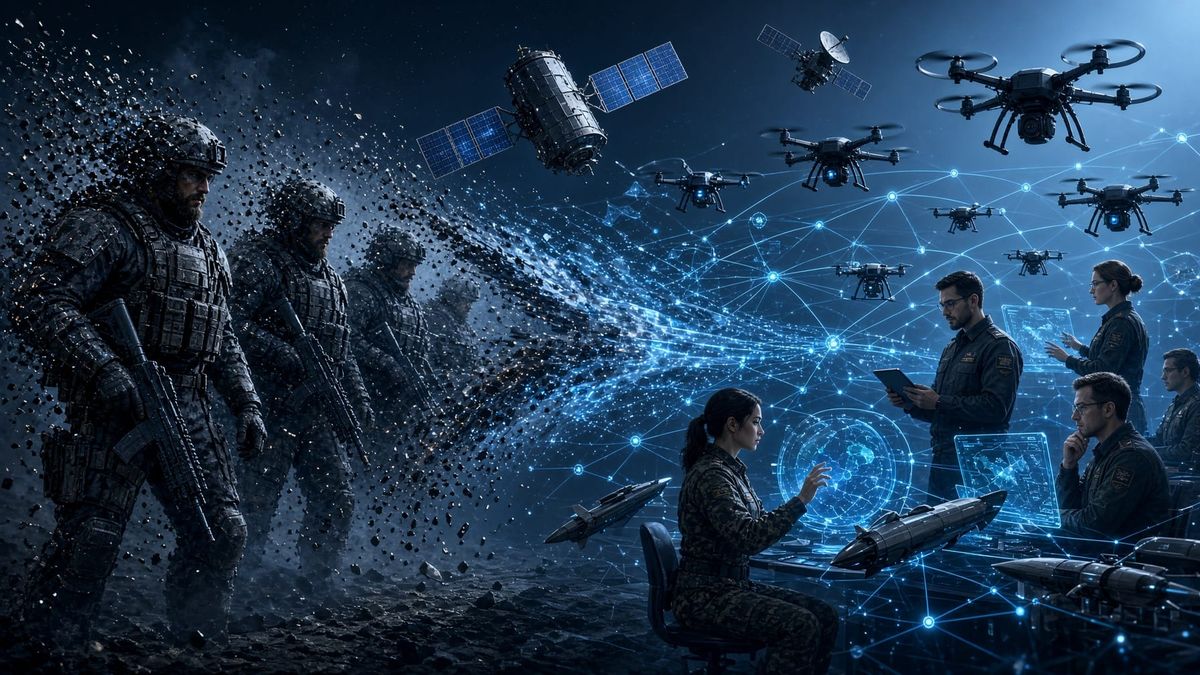
But modern high-intensity warfare is increasingly decided by whether a force can find, understand, target, strike, assess, and adapt faster than its opponent. That makes intelligence and the entire sensor-to-shooter architecture central:
1. The fusion of enormous amounts of data from ISR.
2. Building and maintaining reliable C4ISR.
3. Contesting the electromagnetic spectrum and cyberspace.
4. Operating autonomous or semi-autonomous platforms and systems, and using machine-assisted targeting and decision support.
5. Operating precision-guided weapons and long-range fires.
6. Managing communications and PNT.
7. Managing integrated air and missile defence.
8. Handling logistics, maintenance, software, industrial capacity, and munitions production.
Ukraine has made this abundantly clear. A physically unimpressive analyst identifying a target from satellite imagery, a software engineer improving autonomous navigation under GNSS denial, or an EW operator locating an emitter can contribute heavily to the destruction of enemy combat power while saving lives. In Ukraine, rapid innovation, technology procurement, intelligence, and management are just as critical as boots on the ground. Arguably, those capabilities are among the principal reasons Ukraine has remained in the fight.
Consider what Ukraine has actually built during the war. DELTA, its cloud-based battlefield-management ecosystem, integrates information from drones, satellites, radars, trackers, intelligence reporting, and other sensors into a common operational picture. It has evolved well beyond a digital map. Its modules now handle UAV video, reconnaissance coordination, target management, secure communications, and the integration of robotic systems. Ukraine's Ministry of Defence says DELTA is used to support targeting against thousands of enemy assets each day. NATO has tested it for interoperability, and Ukrainian forces have demonstrated its use in actual combat and multinational exercises.
Ukraine has also turned unmanned systems into an industrial and organizational ecosystem rather than treating drones as accessories to conventional formations. FPV drones conduct reconnaissance and strike missions at enormous scale. Unmanned ground vehicles perform reconnaissance, mine-related tasks, logistics, and increasingly combat functions. Ukraine created an entire Unmanned Systems Forces branch in 2024. At sea, relatively inexpensive unmanned surface vessels have helped impose substantial costs on a Russian Black Sea Fleet that entered the war with an overwhelming conventional advantage. Ukrainian maritime drones have attacked ships and naval infrastructure and have evolved sufficiently that armed variants have even shot down Russian combat aircraft.
The important lesson is not that drones have replaced traditional weapons. Ukraine still depends desperately on artillery, infantry, air defence, fortifications, engineering, logistics, and enormous quantities of ammunition. The lesson is that the effectiveness of those things increasingly depends on the information and technological architecture surrounding them.
A Ukrainian artillery battery is far more dangerous when reconnaissance drones can locate a target, software can distribute its coordinates, commanders can allocate the appropriate weapon, and battle-damage assessment can begin almost immediately. An FPV drone is useful because operators, engineers, intelligence personnel, manufacturers, software developers, and EW specialists form an ecosystem around something that may cost only a few hundred or a few thousand dollars. When Russian jamming changes, frequencies change. When a particular drone design stops working, components or software are modified. When a new requirement appears at the front, Ukrainian developers can sometimes respond on timescales that would be almost inconceivable under the traditional American procurement system.
That capacity for rapid adaptation may be one of Ukraine's most important military achievements. War has become an extraordinarily fast evolutionary environment. A technological advantage may last months, weeks, or occasionally days before the enemy develops a countermeasure. The organizations that learn fastest therefore acquire combat power that cannot be measured simply by counting tanks, aircraft, ships, or soldiers.
The same becomes even more pronounced in a Western Pacific war.
Imagine the opening hours of a major conflict over Taiwan. Long before large American ground formations become relevant, both sides would be trying to understand an enormous and rapidly changing battlespace while simultaneously making it harder for the other side to do the same.
The PLA has spent decades constructing a military around precisely this problem. Chinese doctrine has developed the concept of "systems destruction warfare": attacking the networks and operational systems that allow an opposing military to function as an integrated whole. China's military capabilities now encompass increasingly sophisticated space, counterspace, cyber, electronic-warfare, missile, air, maritime, and ISR systems. The Pentagon assesses that the PLA continues to develop direct-ascent anti-satellite weapons, co-orbital capabilities, electronic-warfare systems and directed-energy counterspace capabilities alongside its conventional forces.
A war could therefore begin with an extraordinary contest over information.
The United States and its allies would have to assume that major fixed installations within range of Chinese weapons could come under attack. Kadena, Andersen, ports and logistics facilities, fuel storage, ammunition depots, radar sites, communications infrastructure, command facilities, and other nodes supporting American operations would become extraordinarily valuable targets. China possesses large inventories of ballistic and cruise missiles capable of threatening bases throughout the first island chain, while systems such as the DF-26 extend that threat to Guam. RAND has long identified dispersed basing, hardening, missile defence, and changes in operating practices as essential responses to this problem.
At the same time, American commanders would be trying to locate Chinese missile launchers that can move and hide, identify ships and submarines across enormous stretches of ocean, distinguish real targets from decoys, track aircraft, monitor Chinese air-defence systems, understand the electromagnetic environment, and determine which elements of the PLA command-and-control architecture remain operational.
Then they have to get that information to somebody capable of doing something about it.
Satellites may be jammed, dazzled, attacked, or otherwise disrupted. Communications links may be degraded. Cyberattacks may interfere with networks. GNSS signals may become unreliable. Aircraft transmitting freely may reveal their positions. Ships may have to control their emissions to avoid becoming targets. A sensor capable of detecting something may have only a brief opportunity to pass its information before it moves, is jammed, or is destroyed.
The decisive question becomes whether a distributed force can continue constructing a coherent picture from fragments of information and turn that information into weapons effects while the enemy is actively dismantling the network doing it.
The PLA faces exactly the same problem. This is why the first battle of a Pacific war could resemble a contest between two enormous reconnaissance-strike systems trying to overwhelm or dismantle each other. The Pentagon's own description of PLA planning emphasizes information dominance, space, cyber and electronic warfare, strategic intelligence collection, and the ability to delay or deny third-party intervention during a Taiwan contingency.
Surviving that environment requires a very different conception of resilience from simply making individual soldiers tougher.
Aircraft need to disperse rather than sit conveniently concentrated on a handful of large airfields. The Air Force's Agile Combat Employment concept is explicitly designed around this problem: operating from distributed locations, complicating enemy targeting, accepting some loss of efficiency in exchange for survivability, and maintaining operations within range of long-range precision fires.
Fuel and ammunition have to be dispersed. Cratered runways have to be repaired quickly. Logistics networks have to function despite attacks on ports and bases. Command-and-control systems need redundant paths. Units need to continue operating when communications with higher headquarters are compromised. Navigation systems need PNT alternatives when GNSS becomes unreliable. Autonomous platforms need enough onboard intelligence to continue useful missions when their datalinks are degraded.
Munitions are another constraint. CSIS wargaming has repeatedly demonstrated the importance of long-range anti-ship weapons and the vulnerability of aircraft caught on the ground; more recent CSIS analysis notes that in multiple simulations the United States exhausted inventories of some long-range missiles during the first week of a Taiwan conflict.
That is an industrial problem as much as a military one. The courage of the person pulling the trigger is irrelevant when there is nothing left to fire.
All these factors, industrial, planning, operational, and managerial, become part of a complex mosaic. The modern battlespace and its supporting infrastructure have changed substantially even over the past decade, and the skill sets required to build, procure, sustain, and operate its components are different from those the military needed in previous conflicts.
The demand for these skill sets produces a personnel-policy problem when policy fetishizes the archetypal soldier. The military needs exceptional analysts, engineers, intelligence and EW specialists, cyber personnel, software developers, drone operators, maintainers, acquisition specialists, and logisticians. Some of the people you most desperately want doing those jobs will never resemble an infantry recruiting poster (or, if so, only by accident).
A brilliant 120-pound signals analyst who can reconstruct an enemy electronic order of battle may be considerably more valuable in a particular billet than someone who can bench-press twice his body weight. A gifted programmer who figures out how to make an autonomous aircraft navigate accurately after losing satellite navigation may affect the outcome of hundreds of engagements without ever seeing the enemy. A logistics officer who develops a system capable of keeping dispersed aircraft fuelled and armed after the primary airbase has been cratered may preserve more combat power than an entire infantry company.
I am not suggesting lower standards where physical standards are operationally necessary. An infantryman who cannot carry the required equipment or evacuate a wounded comrade is a liability. A sailor must be capable of performing emergency duties aboard a damaged ship. Some military occupations require high levels of physical endurance.
The mistake is turning the requirements of those occupations into a generalized cultural ideal for an institution containing hundreds of radically different specialties.
Selecting or culturally rewarding personnel according to a generalized conception of physical toughness can actively reduce combat effectiveness if doing so makes the institution less attractive to precisely the technical talent it needs. The military competes for engineers, programmers, mathematicians, intelligence analysts, scientists, cyber specialists, and other highly skilled people against organizations that generally do not care how many pull-ups they can perform. As far as I know, Microsoft still does not require bench-press standards for its employees.
The irony is that an actual "warrior ethos," properly understood, ought to mean doing whatever produces victory under current technological conditions.
In 1944, victory required mass, artillery, armor, logistics, industrial production, and enormous quantities of human courage. While those things remain relevant, today warfare has acquired layers of technological complexity that increasingly determine how effectively traditional combat power can be employed. C4ISR, spectrum operations, autonomous systems, precision fires, software, space systems, cyber capabilities, and enormous data-processing requirements now sit within the kill chains connecting many weapons to the targets they are supposed to destroy.
Ukraine has demonstrated what happens when a military becomes extraordinarily good at adapting technology under pressure. A future war with China would test the same principle on a scale and across distances the world has never experienced.
And, if anything, it should be clear that what ails the U.S. military in its war with Iran is not a lack of chisel-jawed warriors (or wannabe warriors like Hegseth), but shortages of precision weapons, insufficient industrial capacity to replace them quickly, and the difficulty of sustaining combat power across enormous distances, all while keeping carriers and their crews on extraordinarily extended deployments.
A military that romanticises the appearance of lethality while another military gets much better at the machinery that actually produces lethality has misunderstood warfare.
Like much of what this administration stands for, Pete Hegseth's idea for the U.S. military is unserious and anachronistic. Brawn is not going to win the next war. Brains are. Maybe that makes for a less interesting movie, but warfare is serious business and should not be designed for the big screen by amateurs.