Proposal for Understanding Political Networks

Toward a Cohomological Framework for Russian Elite Interlinkages
From Multiplex Networks to Persistent Sheaf Cohomology
March 2026
Abstract
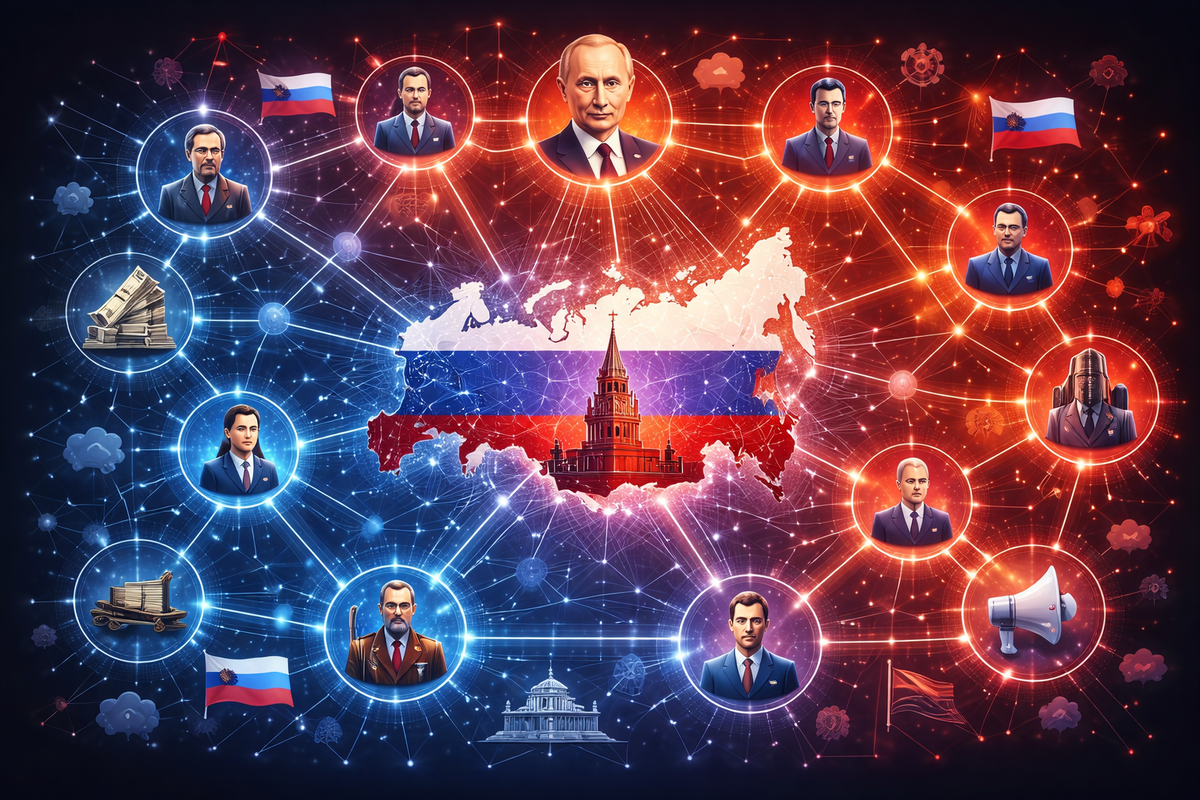
This paper develops a rigorous algebraic-topological framework for studying interlinkages across the Russian military, civilian, political, economic, industrial, and criminal classes. The central claim is methodological rather than sensational: if an analyst is confronted with a heterogeneous, multi-source, partially observed system of relations, then ordinary graph analytics alone are structurally insufficient. The relevant object is not merely a graph, but a filtered, typed, higher-order relational complex endowed with consistency constraints. In that setting, cohomology becomes useful because it measures what standard graph metrics do not: persistent multiscale cycles, higher-order cavities, and obstructions to stitching locally credible fragments into a globally coherent picture.
We formalize a six-layer multiplex system, define a simplicial or cell-complex lift that captures higher-order interlocks, and then equip the complex with a cellular sheaf encoding source reliability, edge semantics, temporal validity, and directional constraints. Ordinary simplicial cohomology captures robust structural cycles; sheaf cohomology captures failures of local-to-global consistency; persistent variants separate stable features from noise across thresholds, times, and confidence levels. We then show how this framework can be operationalized for intelligence analysis, corruption mapping, sanctions evasion studies, civil-military fusion analysis, cartel-state penetration, and corporate-governance risk. The document is intended as a serious research note rather than a sloganized "TDA for OSINT" piece.
Introduction
Analysts studying elite capture, state-crime interpenetration, sanctions evasion, military-industrial patronage, or regime resilience are often handed a familiar mess: entities of many types, ties of many meanings, heterogeneous evidence quality, and repeated local contradictions. Standard graph analytics remain useful, but they are structurally underpowered in at least three ways.
First, ordinary graphs privilege pairwise relations, whereas real systems often contain higher-order interactions such as co-membership in a procurement ring, a sanctions-avoidance consortium, a patronage clique, or a joint venture with layered beneficial ownership. Contemporary network science has therefore moved well beyond simple graphs toward multiplex, multilayer, hypergraph, and simplicial representations of higher-order systems. Second, topological data analysis has shown that multiscale topological invariants can recover structural organization that local graph statistics systematically miss. Third, applied sheaf theory has emerged as a principled formalism for local-to-global inference, data fusion, and consistency analysis over networks and cell complexes.
For the Russian case, the intuition is straightforward. The same actor may simultaneously occupy military, state, business, industrial, and criminal interfaces. A governor may mediate industrial contracts, a security service officer may interact with criminal finance, and a nominally private logistics firm may be a conduit between procurement, customs, and illicit transport. The analytic question is not simply who is central. It is also:
- which cross-layer cycles are robust across data thresholds
- which apparent closures are actually unfilled higher-order cavities
- where local observations cannot be made globally consistent
- which structures persist over time rather than appearing only as threshold artifacts
Persistent homology on networks was developed precisely to extract multiscale topological structure that local graph measures miss. More recent work extends this line via cellular sheaves, persistent sheaf cohomology, and persistent sheaf Laplacians, allowing topology and heterogeneous non-topological labels to be integrated in the same model. These developments make a cohomological treatment of elite interlock systems not only mathematically legitimate but timely.
Why Cohomology Rather Than Only Graph Theory?
Let $G=(V,E)$ be a directed weighted graph of entities and observed ties. Classical graph statistics, such as degree, betweenness, eigenvector centrality, assortativity, or community structure, are useful summaries. But they remain largely local, dyadic, or aggregate. They do not directly encode the difference between a cycle that is merely an artifact of thresholding pairwise ties and a cycle that persists across scales and survives higher-order closure tests.
Nor do they handle, in a principled way, the analytic problem that two data sources can each be locally plausible while being globally incompatible once one attempts to integrate them into a single relational account. Sheaf cohomology is built precisely for this local-to-global problem. Informally, a sheaf attaches admissible data to cells of a complex and restriction maps tell us what counts as consistency when local observations overlap. Cohomology then measures obstructions to constructing global sections from local data.
This matters operationally. In corruption or state-crime analysis, one often has slices of truth coming from customs records, court filings, sanctions lists, leaked ledgers, procurement metadata, shipping traces, telecom metadata, and human reporting. The issue is not merely missing data. The issue is whether these local sections can coexist in one globally coherent model. Nontrivial first sheaf cohomology is an indicator that the answer is "not without contradiction, hidden variables, or model revision."
A Six-Layer Multiplex System
Let
$$
\mathcal{L}={M,C,P,E,I,K}
$$
be the set of layers, where
$M$: military/security actors
$C$: civilian/administrative actors
$P$: political actors and patronage structures
$E$: economic/financial actors
$I$: industrial/defense-production actors
$K$: criminal or illicit-market actors
We define a typed entity set
$$
V=\bigsqcup_{\tau\in T} V_\tau
$$
where $T$ is a type system, for example person, firm, ministry, military unit, shell company, bank, front organization, logistics node, port, criminal group, or beneficial owner.
For each layer $\ell \in \mathcal{L}$, let
$$
G_\ell=(V,E_\ell,w_\ell,\sigma_\ell)
$$
be a directed weighted relation graph with weight function
$$
w_\ell:E_\ell\to\mathbb{R}_{\ge 0}
$$
and semantic label map $\sigma_\ell$ assigning a tie meaning such as command, ownership, board overlap, procurement, kinship, financing, coercion, protection, transport, bribery, or laundering.
A purely multiplex representation is then
$$
\mathfrak{G}={G_\ell}_{\ell\in\mathcal{L}}
$$
with optional interlayer couplings
$$
\Gamma_{\ell\ell'} \subseteq V\times V
$$
which record type-changing or role-changing correspondences across layers. This is already better than a single aggregated graph, because aggregation destroys the semantic distinction between, say, bribery, command, and co-membership.
However, a multiplex graph is still dyadic. To represent triadic and higher-order interlocks, we lift it to a simplicial or cellular object.
From Multiplex Graphs to a Simplicial Complex
Let $K$ be a finite simplicial complex constructed from the data. There are several admissible constructions.
Clique or Flag Lift
Given a thresholded multiplex adjacency rule, one may form a flag complex on the aggregated or typed graph. This is computationally convenient but can hallucinate high-dimensional simplices from pairwise ties alone.
Relation-Specific Simplices
A more defensible approach is to introduce a $k$-simplex only when there is direct evidence of a $(k+1)$-way interaction. For instance, if a procurement shell, customs official, logistics intermediary, and sanctioned end user appear in the same transaction dossier, one records a 3-simplex rather than inferring it from all pairwise edges.
Hypergraph-to-Simplicial Lift
If the raw data are naturally hypergraphical, such as co-attendance, co-signature, joint shipment, or common beneficial ownership, one may begin with a hypergraph and pass to an associated simplicial complex only after preserving provenance.
The point is analytic discipline. In elite-network work, false closure is easy. A topological hole that survives only because we refused to fill unsupported simplices is often more informative than a visually dense graph.
Cochains, Cohomology, and Interpretation
Let $K$ be a finite simplicial complex over a field $\mathbb{K}$, typically $\mathbb{R}$ for weighted computations or $\mathbb{F}_2$ for combinatorial persistence. For each $k \ge 0$, let
$$
C^k(K;\mathbb{K})=\operatorname{Hom}(C_k(K;\mathbb{K}),\mathbb{K})
$$
be the space of $k$-cochains, with coboundary
$$
\delta^k \colon C^k(K;\mathbb{K}) \to C^{k+1}(K;\mathbb{K}),
\qquad
\delta^{k+1} \circ \delta^k = 0
$$
The $k$th cohomology group is
$$
H^k(K;\mathbb{K})=\ker \delta^k / \operatorname{im}\delta^{k-1}
$$
Interpretively:
- $H^0$ captures connected components or disconnected sectors
- $H^1$ captures one-dimensional holes, that is, robust cycles not filled by higher-order closure
- $H^2$ and above capture higher-order cavities, which can matter when the data genuinely contain structured multi-way interactions
In practice, $H^1$ is already operationally valuable. A persistent $1$-class in a filtered interlinkage complex can represent a durable circuit of mediation and influence spanning multiple layers, for example political patronage, industrial procurement, financial routing, and criminal enforcement, without collapsing into a fully integrated clique. Such a cycle is not proof of conspiracy. It is a structural motif that resists dyadic simplification.
Filtration and Persistent Cohomology
Because intelligence and investigative data are threshold-sensitive, one should not compute topology on a single arbitrary cut. Instead, define a filtration
$$
K_{t_1} \subseteq K_{t_2} \subseteq \cdots \subseteq K_{t_m}
$$
where the parameter may encode relation strength, source confidence, temporal accumulation, or multimodal consensus score.
Persistent cohomology studies the induced maps
$$
H^k(K_{t_i};\mathbb{K}) \to H^k(K_{t_j};\mathbb{K}), \qquad t_i \le t_j
$$
and records birth and death of cohomology classes via barcodes or persistence diagrams.
Operational interpretation:
- short-lived classes are likely threshold artifacts or local irregularities
- long-lived classes indicate structurally robust motifs that survive uncertainty in analyst choices
- comparison across time-indexed filtrations can reveal whether sanctions, arrests, battlefield attrition, or political reshuffles merely reroute the system or genuinely collapse a structural channel
Applying $H^k(-;\mathbb{K})$ to a filtration ${K_t}_{t\in T}$ yields a persistence module
$$
t \mapsto H^k(K_t;\mathbb{K})
$$
together with the induced maps
$$
H^k(K_s;\mathbb{K}) \to H^k(K_t;\mathbb{K}), \qquad s \le t
$$
Sheaf-Theoretic Lift for Local-to-Global Consistency
Ordinary cohomology studies the topology of the relational scaffold. A sheaf adds semantics and consistency laws.
Let $X$ be a finite cell complex derived from the simplicial model. A cellular sheaf $\mathcal{F}$ assigns to each cell $\sigma$ a vector space $\mathcal{F}(\sigma)$ and to each face relation $\tau \le \sigma$ a linear restriction map
$$
\rho_{\sigma\tau} : \mathcal{F}(\sigma) \to \mathcal{F}(\tau)
$$
satisfying the usual functorial compatibility.
In this application, a stalk can encode local state spaces such as:
- admissible role labels of an actor at a node
- allowable transaction categories on an edge
- time-valid interpretations of a procurement simplex
- source-specific confidence vectors
- compatibility classes for legal, logistical, or organizational constraints
The sheaf cochain complex is
$$
C^k(X;\mathcal{F}) = \bigoplus_{\dim(\sigma)=k}\mathcal{F}(\sigma)
$$
with coboundary built from signed restriction maps, and sheaf cohomology
$$
H^k(X;\mathcal{F})
$$
measures obstructions to gluing local assignments into global sections.
This has a direct intelligence interpretation. Suppose local evidence says:
- a logistics firm is privately controlled
- a customs official has no formal relation to it
- a sanctions-evading shipment was authorized through a separate ministry channel
- a beneficial owner appears only in leaked ledgers
Each local statement may be individually credible. But when one attempts to glue them into a globally consistent assignment of control, timing, and channel attribution, the sheaf may produce an obstruction. That obstruction is not a bug. It is precisely the mathematical representation of "these reports do not jointly fit under the current model."
Hodge-Theoretic and Spectral View
With inner products on cochains, one obtains a Hodge Laplacian
$$
\Delta_k = \delta^{k-1} ( \delta^{k-1} )^{\ast} + ( \delta^{k} )^{\ast} \delta^{k}
$$
whose harmonic representatives satisfy
$$
\ker \Delta_k \cong H^k
$$
This matters computationally because harmonic cocycles provide interpretable representatives of persistent classes. Rather than only saying "there exists a nontrivial $1$-class," one can identify which relations carry the mass of a harmonic representative, thereby highlighting the most topologically responsible parts of the interlinkage system.
Recent work on sheaf Laplacians and persistent sheaf Laplacians extends this idea to sheaf-valued settings, combining structural topology with attribute-level consistency. This is promising for practical analyst workflows because it offers both detection and explanation: a robust class can be paired with an evidentiary witness.
Formal Modeling of Russian Interlinkages
To make this operational, define an evidentiary tensor
$$
\mathcal{A}_{ij}^{(\ell,r,t,s)}
$$
where:
- $i, j$ index entities
- $\ell \in \mathcal{L}$ is the layer
- $r$ is the semantic relation type
- $t$ is a time bin or interval
- $s$ is source provenance or modality
An analyst-defined aggregation functor
$$
\Phi : \mathcal{A} \mapsto ( K_{t}, \mathcal{F}_{t} ) _{t \in T}
$$
produces a filtered complex together with a sheaf at each scale or time. The construction should be explicit and auditable:
- which relation types generate 1-simplices
- which higher-order events generate 2- or 3-simplices
- how confidence affects filtration values
- how contradictory sources map to stalk spaces
- which restrictions encode legal, temporal, or organizational compatibility
The result is not a map of Putin’s cronies. It is a functorial pipeline from messy heterogeneous evidence to algebraic invariants and obstruction witnesses.
Operational Use Cases
1. Regime Resilience and Succession Architecture
Persistent cycles spanning political, security, financial, and industrial layers may indicate resilient channels of coordination that survive personnel turnover. If a nominally central actor disappears but the same cohomology classes persist, the system is structurally robust rather than leader-fragile.
2. Sanctions Evasion
A persistent $1$-class linking ports, brokers, shell firms, banks, and commodity intermediaries may reveal a durable evasion corridor. Sheaf obstructions can expose inconsistencies between declared ownership structures and observed transaction pathways.
3. State-Crime Interface
If criminal groups, customs brokers, municipal officials, and transport firms form robust higher-order cavities rather than dense cliques, this may suggest compartmented operational architectures designed to preserve deniability while maintaining throughput.
4. Military-Industrial Procurement
Cycles linking ministries, state firms, subcontractors, logistics firms, and offshore financial entities can indicate procurement circuits. A higher-order cavity can be more informative than a filled clique because it marks where closure is conspicuously absent despite repeated pairwise coordination.
5. Counterintelligence and Deception Detection
If a narrative fed by one source class glues locally but generates nontrivial sheaf cohomology against financial or communications evidence, the mismatch flags a candidate deception channel or an inadequately specified model.
A Minimal Proposition
Even at a proposal stage, one can state a modest but useful proposition justifying persistent cohomology over any single threshold.
Proposition. Let ${K_t}_{t\in T}$ be a filtration of finite simplicial complexes indexed by a totally ordered parameter set $T$. For fixed degree $k$, the assignment $t \mapsto H^k(K_t;\mathbb{K})$ together with the maps induced by inclusions $K_s \hookrightarrow K_t$ for $s \le t$ defines a persistence module. If a cohomology class $[\alpha]\in H^k(K_t;\mathbb{K})$ has a long persistence interval, then its existence is invariant under a broad range of threshold choices encoded by the filtration.
Proof sketch. Functoriality of cohomology under inclusions yields the persistence module. Long persistence means the class survives the induced maps across a nontrivial interval of parameter values. Therefore it is not an artifact of one arbitrarily chosen threshold. The proposition says nothing about semantic interpretation, only about multiscale structural stability.
Expansion to Other Domains
The framework is portable because the mathematics is about structured heterogeneity and local-to-global constraints, not about Russia per se.
China and Civil-Military Fusion
Replace the Russian six-layer system with party-state, PLA, SOE, university, venture-capital, and overseas procurement layers. The same machinery can detect robust circuits and gluing obstructions across nominally civilian and military interfaces.
Cartel-State Penetration
In Latin American or Balkan cases, one can model criminal groups, police, customs, politicians, transport firms, and financial facilitators as a multiplex simplicial system. Persistent cohomology is then a way to separate durable penetration structure from noisy case-specific co-offending.
Sanctions Evasion and Maritime Logistics
Entities become vessels, insurers, managers, shell firms, ports, brokers, and commodity traders. Sheaf restrictions encode legal and temporal compatibility of ownership, flagging, transshipment, and AIS anomalies.
Corporate Governance and Hidden Control
For public companies, PE structures, and beneficial ownership networks, a sheaf can encode consistency between registry data, board overlaps, control rights, contractual rights, and accounting disclosures. Nontrivial sheaf cohomology then signals that the observed local disclosures do not assemble into a globally consistent governance story.
Cyber and Influence Ecosystems
Nodes may be operators, infrastructure, malware families, cutouts, cryptocurrency wallets, media fronts, and influence channels. Higher-order simplices arise from campaigns or jointly observed operational bundles. Persistence tells us which topological signatures survive evidentiary resampling.
What This Method Does Not Do
It is worth being blunt.
- Cohomology does not identify causation.
- It does not prove criminal intent.
- It does not solve entity resolution.
- It does not repair biased or adversarial source collection.
- It does not remove the need for substantive area expertise.
What it does do is impose disciplined structure on a class of problems that are otherwise handled with hand-wavy diagrams and analyst intuition alone. That is already a substantial upgrade.
Research Agenda
Several extensions are natural.
- Directed sheaf models. Many elite systems are asymmetric. Recent work on directed or learnable sheaf Laplacians suggests a path for modeling directional influence and non-reciprocal control more faithfully.
- Probabilistic sheaf cohomology. Replace deterministic stalk compatibility with Bayesian compatibility maps and compute posterior persistence under uncertainty.
- Temporal sheaves on product spaces. Build sheaves on $X \times T$ to model how local consistency evolves over time rather than recomputing independent snapshots.
- Intervention analysis. Compare persistence diagrams before and after sanctions, arrests, leadership changes, or battlefield shocks to determine whether structure was disrupted or merely re-routed.
- Analyst-facing explanation layers. Use harmonic representatives and sheaf obstruction witnesses to produce readable evidentiary narratives rather than dumping Betti numbers on people who understandably have better things to do.
Conclusion
The use of cohomology in elite-network analysis should not be sold as mathematical mysticism. It should be sold as what it is: a rigorous framework for representing higher-order relational structure, multiscale stability, and local-to-global consistency constraints in heterogeneous systems. For Russian interlinkage analysis, this is particularly apt because the object of interest is not merely a social graph but a layered, role-shifting, partially hidden architecture in which military, political, industrial, economic, civilian, and criminal strata can overlap, mediate, or deliberately fail to close.
Ordinary graph analysis tells us where the traffic is. Cohomology tells us whether the system has robust cycles, cavities, and gluing obstructions that survive threshold changes and data fusion. Sheaf cohomology, in particular, provides a mathematically serious language for a problem intelligence analysts deal with constantly: local reports that almost fit together, except when they do not. When the object is a regime-linked interpenetration system rather than a cleanly bounded organization, that distinction is not cosmetic. It is the analysis.
Appendix: Suggested Dataset Schema
Entities
entity_id: stable unique identifierentity_type: person, firm, ministry, military unit, bank, vessel, shell company, criminal group, etc.name_canonical: canonical namename_aliases: known aliases and transliterationsjurisdiction: country or legal jurisdictionrole_vector: numeric latent-role embedding or analyst-coded featuressanctions_status: sanction designation metadataconfidence_entity: confidence in entity resolution
Relations
relation_id: stable relation identifiersource_entity: origin nodetarget_entity: destination nodelayer: $M, C, P, E, I, K$relation_type: command, ownership, financing, kinship, bribery, logistics, communications, coercion, etc.weight: strength or analyst-defined scalarstart_time, end_time: temporal validity windowsource_provenance: registry, leak, court filing, sanctions list, HUMINT, SIGINT-derived lead, media, etc.confidence_relation: confidence score in $[0,1]$
Higher-Order Events
event_id: stable event identifierparticipants: set of involved entitiesevent_type: joint venture, shipment, meeting, procurement package, shell chain, bribery episode, etc.geometry: hyperedge or simplex specificationtime_window: event intervalconfidence_event: confidence score
Sheaf Constraints
constraint_id: stable identifiercell: node, edge, or simplex to which the stalk is attachedstalk_basis: basis description for local interpretation spacerestriction_map: matrix encoding compatibility to a faceconstraint_type: temporal, legal, financial, organizational, source-consistency, etc.
Notation Summary
- $\mathcal{L}$: set of analytic layers
- $V$: entity set
- $G_\ell$: layer-specific graph
- $K$: simplicial or cellular complex
- $C^k(K;\mathbb{K})$: $k$-cochains
- $H^k(K;\mathbb{K})$: ordinary cohomology
- $\mathcal{F}$: cellular sheaf
- $H^k(X;\mathcal{F})$: sheaf cohomology
- $\Delta_k$: Hodge Laplacian
- $K_t$: filtration member at parameter $t$
References
- M. E. Aktas, E. Akbas, and P. E. Fatkulin, Persistence Homology of Networks: Methods and Applications, Applied Network Science, 4, 61 (2019). Preprint DOI: 10.48550/arXiv.1907.08708.
- C. Bick, E. Gross, H. A. Harrington, and M. T. Schaub, What Are Higher-Order Networks?, SIAM Review, 65(3), 686-731 (2023).
- J. Curry, Sheaves, Cosheaves and Applications, PhD thesis, University of Pennsylvania (2014).
- T. Diviák, J. K. Dijkstra, and T. A. B. Snijders, Structure, Multiplexity, and Centrality in a Corruption Network: The Czech Rath Affair, Trends in Organized Crime, 22, 274-297 (2019).
- R. Ghrist and Y. Hiraoka, Applications of Sheaf Cohomology and Exact Sequences on Network Coding Problems, Proceedings of the 2011 IEEE Information Theory Workshop, 145-149 (2011).
- R. Ghrist, Elementary Applied Topology, Createspace (2014).
- J. Hansen and R. Ghrist, Toward a Spectral Theory of Cellular Sheaves, Journal of Applied and Computational Topology, 3, 315-358 (2019).
- M. Kivelä, A. Arenas, M. Barthélemy, J. P. Gleeson, Y. Moreno, and M. A. Porter, Multilayer Networks, Journal of Complex Networks, 2(3), 203-271 (2014).
- M. Robinson, Sheaves Are the Canonical Data Structure for Sensor Integration, Information Fusion, 36, 208-224 (2017).
- F. Russold, Persistent Sheaf Cohomology, Preprint (2022). DOI: 10.48550/arXiv.2204.13446.
- X. Wei, K. Xia, and G.-W. Wei, Persistent Sheaf Laplacians, Journal of Applied and Computational Topology (2025). PMCID: PMC12442877.
- S. Majhi, M. Perc, and D. Ghosh, Dynamics on Higher-Order Networks: A Review, Journal of the Royal Society Interface, 19:20220043 (2022).
- Z. Su, G.-W. Wei, and K. Xia, Topological Data Analysis and Topological Deep Learning Beyond Persistent Homology: A Review, Preprint / review literature (2025).